
Are your waste management operations running as efficiently as they could be, or are you essentially managing a multi-million dollar fleet based on guesswork? For councils and private waste contractors, the side loader waste truck is the workhorse of the fleet. However, it is also one of the most complex vehicles to manage. Between navigating narrow residential streets, managing a high-frequency robotic arm, and ensuring the safety of pedestrians who often treat heavy machinery with surprising nonchalance, the stakes are incredibly high.
If you aren’t leveraging modern telematics and safety technology, you aren’t just behind the curve: you’re likely bleeding money and exposing your organisation to unnecessary risk.
![[HERO] Smart Waste Management: How Telematics and Safety Tech Transform Side Loader Operations](https://cdn.marblism.com/C4qPSnbncq_.webp)
How Accurate is Your Bin Tracking, Really?
In the world of waste management, “I think we picked up that bin” isn’t a good enough answer. When a resident calls the council claiming their bin was missed, how long does it take your team to verify the truth? Without automated tracking, it’s a game of “he-said, she-said” that wastes administrative time and fuel for unnecessary go-backs.
Smart waste management systems integrate bin-lift sensors directly into the vehicle’s telematics. Every time that side loader arm engages, a data point is created. By combining this with GPS and RFID technology, you get a real-time digital map of every single pickup.
This level of granular data allows you to:
- Verify service delivery: Instantly prove a bin was or wasn’t out at the time of the truck’s arrival.
- Analyse weight and volume: Identify high-density areas that might require more frequent servicing.
- Improve billing accuracy: For commercial contracts, you can bill based on actual lifts rather than estimated schedules.
If your current system doesn’t provide a live count of pickups, alarm bells should be ringing. You are likely over-servicing some areas while failing others, all while losing the data trail needed for Council and Government reporting.
Route Optimization: Are You Just Driving in Circles?
A side loader can service up to 1,500 homes a day, but that efficiency is quickly eroded by poor route planning. Traditional routes are often static, designed years ago and rarely updated to account for new housing developments or changing traffic patterns.
Are your drivers spending more time idling in traffic than they are lifting bins? Modern telematics doesn’t just track where a truck is; it analyzes the efficiency of how it got there. By using dynamic route optimization, waste management companies can reduce fuel consumption by up to 20%. When you consider the current volatility of diesel costs, these aren’t just marginal gains: they are the difference between a profitable year and a loss.
For more insights on how to rein in these expenses, you might want to look at 5 fleet telematics hacks that cut fuel costs.

Can You See What Your Driver Can’t?
The side loader operator has a difficult job. They are simultaneously driving, monitoring a robotic arm, and watching for hazards in a 360-degree environment. The blind spots on these vehicles are massive, and in a residential setting, those blind spots are often occupied by children, cyclists, or pets.
This is where the distinction between a “camera” and “safety tech” becomes critical. A standard backup camera is better than nothing, but it relies on the driver looking at a screen at exactly the right moment. Smart safety tech, like the systems we implement at MyFleet, uses AI-driven pedestrian detection.
Pedestrian Detection and AI Vision
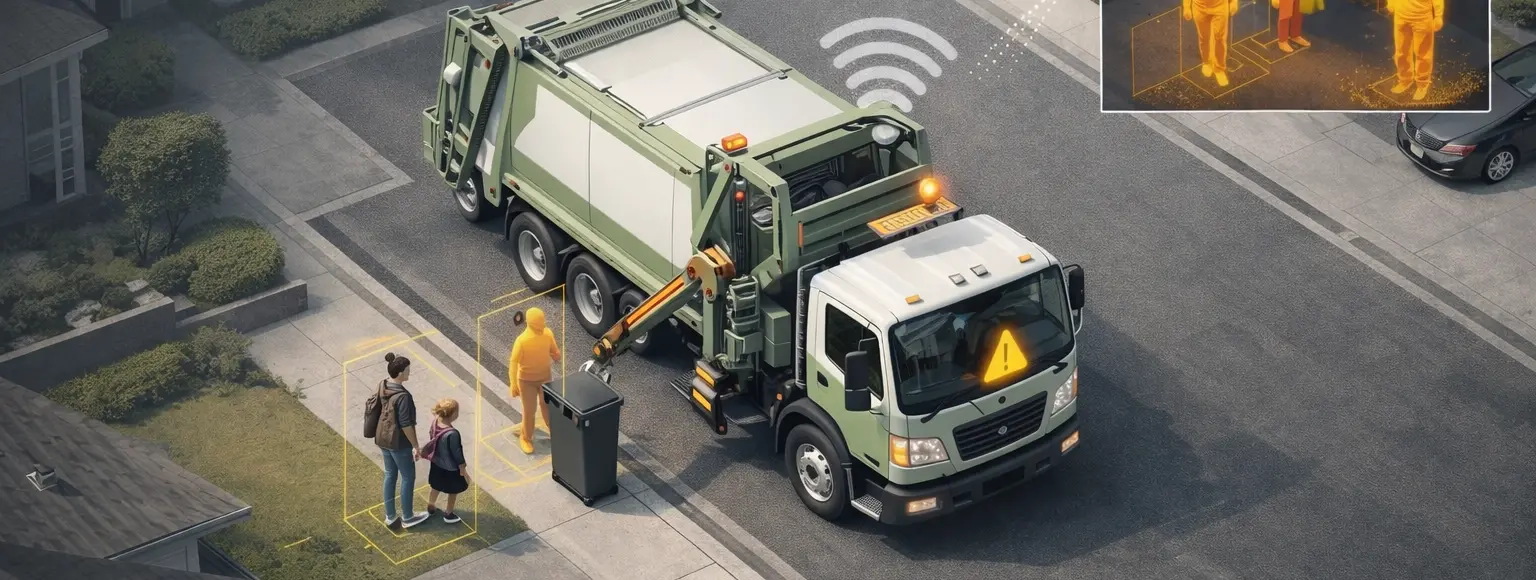
Modern systems don’t just show a video feed; they actively scan the environment. Using AI, the system can distinguish between a stationary object like a parked car and a moving pedestrian. When a human enters a “danger zone” around the truck, the system provides an immediate audible and visual alert to the driver. This split-second warning is often the difference between a near-miss and a catastrophe.
Thermal Cameras for Low-Light Operations
Many waste routes start in the early hours of the morning or operate in poor weather conditions. Standard optical cameras struggle in heavy rain, fog, or total darkness. Thermal imaging cameras, however, detect heat signatures. This means a pedestrian or a person standing behind a bin becomes a glowing, high-contrast silhouette on the driver’s monitor, regardless of the lighting conditions.
Integrating these into your fleet safety and compliance strategy isn’t just about avoiding accidents; it’s about providing your operators with the confidence to work efficiently in high-risk environments.
Why Wait for a Breakdown? Reducing Maintenance Costs
A side loader waste truck is a complex piece of hydraulic machinery. When the arm fails, the truck is useless. Worse, if a hydraulic leak goes unnoticed, it can lead to environmental fines or catastrophic engine failure.
Telematics allows for a shift from reactive maintenance to predictive maintenance. By monitoring the vehicle’s Engine Control Unit (ECU), you can track:
- Hydraulic pressure spikes that indicate a failing pump.
- Engine temperature fluctuations.
- Brake wear and tear based on real-time usage data.
- Transmission health during high-frequency stop-start cycles.
When the system detects a fault code, it doesn’t just turn on a light on the dashboard: it sends an alert to your maintenance manager. This allows you to pull a truck into the workshop for a $500 fix on a Tuesday, rather than paying for a $5,000 emergency repair and a replacement rental on a Friday morning.
If you are serious about asset longevity, you should treat your telematics data as the most important tool in your mechanic’s kit. You can learn more about the broader impact of this technology in our guide on how fleet management software handles reporting.

Is the Investment Worth It?
For any council or waste management firm worth their salt, the initial cost of installing advanced telematics and video safety systems is often the primary concern. However, when you calculate the ROI, the “cost” of the technology quickly becomes a “saving.”
Consider the financial implications of:
- Reduced Insurance Premiums: Insurers look favourably on fleets with active pedestrian detection and video telematics.
- Exoneration from False Claims: High-definition video and GPS data can instantly disprove false claims of property damage or missed service.
- Labour Efficiency: Drivers complete routes faster with less downtime, reducing overtime costs.
- Fuel Savings: Better routes and reduced idling have a direct, measurable impact on the bottom line.
If you’re still relying on paper logs and hoping your drivers see everything, you’re operating on borrowed time. The industry is moving toward a standard where AI integration in fleet telematics isn’t a luxury; it’s a requirement for winning and keeping contracts.
The MyFleet Advantage
At MyFleet, we specialise in bridging the gap between complex hardware and actionable data. We understand that a waste truck is more than just a vehicle; it’s a mobile service centre that needs to be safe, efficient, and accountable.
Whether you are looking to install thermal cameras to protect your early-morning crews or you need a robust bin-tracking solution to satisfy council requirements, we provide the tools to make it happen. Our systems are designed to be intuitive for drivers while providing deep, data-rich insights for management.

What’s Your Next Move?
Technology in the waste sector isn’t just about “gadgets”: it’s about building a more resilient, safer, and more profitable operation. If you’re ready to stop guessing and start knowing exactly what’s happening with your side loader fleet, it’s time to have a conversation.
Don’t wait for a missed bin complaint or, worse, a serious safety incident to prompt a change. Be proactive. Explore our latest news and insights to see how other industries are leveraging these tools, or contact us directly to discuss a tailored solution for your waste management needs.
Ready to secure your fleet? Let’s talk about how we can help you lead the way in smart waste management.