
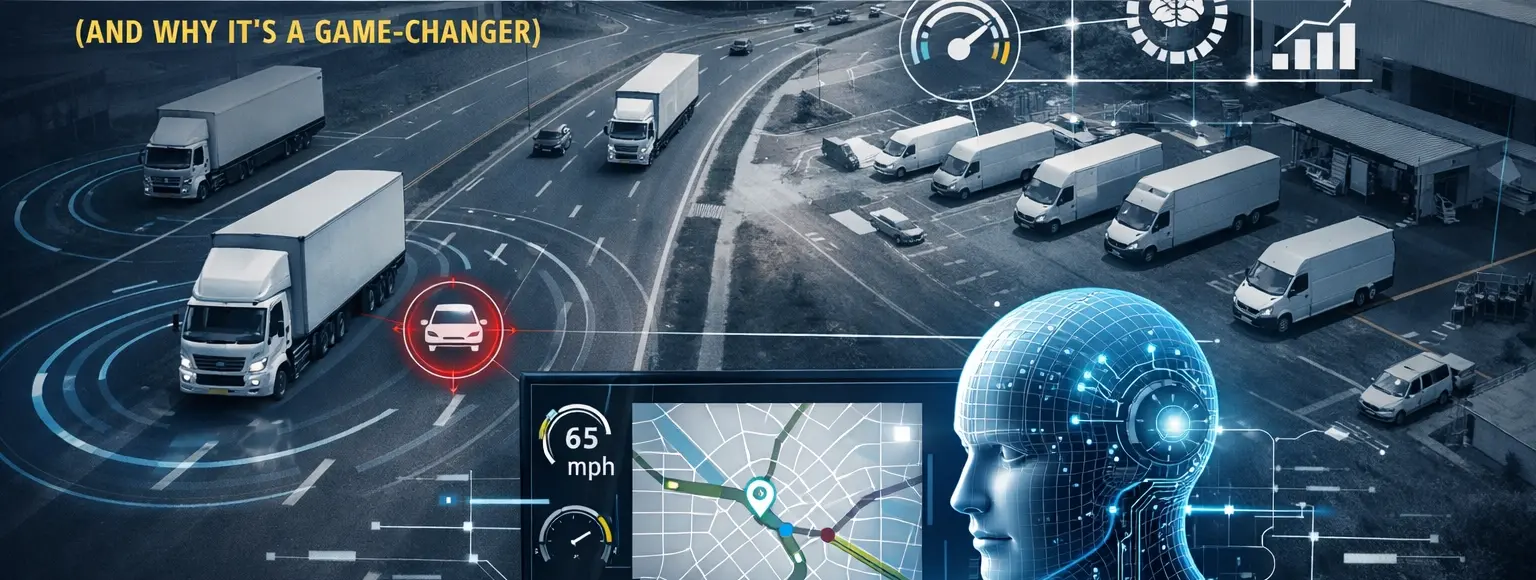
How many times have you logged into your fleet dashboard only to find out about a “harsh braking” event that happened three hours ago? By the time you see it, the moment has passed, the risk has been taken, and the potential accident either happened or was a lucky near-miss.
For years, fleet telematics systems have been reactive. They tell you what happened. But wouldn’t you rather know what is about to happen: and have a system that actually steps in to prevent it?

The industry is currently undergoing a massive shift. We are moving away from passive “dots on a map” gps fleet management and toward proactive AI agents. These aren’t just software updates; they are digital assistants that predict, prevent, and automate the heavy lifting of safety and operations.
If your current provider is still just giving you “breadcrumb” trails and end-of-day reports, alarm bells should be ringing. Here is why proactive AI is about to change everything for your fleet.
Are You Still Managing Your Fleet in the Rear-View Mirror?
Traditional telematics for fleets relies on you: the manager: to be the brain. You look at the data, you spot the trends, and you have the difficult conversations with drivers. But with 10, 50, or 100+ vehicles on the road, you can’t be everywhere at once.
Proactive AI flips the script. Instead of you chasing the data, the AI acts as an “agent” on your behalf. Instead of leaving a pile of video clips for you to review at 5:00 PM, these agents identify which drivers need attention, prepare a complete coaching plan, and can even facilitate self-coaching for the driver in real-time. This isn’t just a tool; it’s a digital safety officer that never sleeps.
How Do “AI Agents” Actually Work in the Cab?

You might be wondering if this is just more “noise” for your drivers. In reality, it’s the opposite. Proactive AI reduces noise by focusing only on what matters.
When you use video telematics equipped with these capabilities, the system provides “zero-latency” feedback. This means the driver gets an audio cue the second they look at their phone or start to drift.
The results are hard to ignore. Fleets implementing this level of proactive AI have seen:
- A 76% drop in accidents through predictive alerts and real-time coaching.
- A 42–57% reduction in distracted driving events, such as mobile phone use and fatigue.
Can AI Really Automate Your Incident Handling?
Any fleet manager worth their salt knows that the hour following an accident is the most critical. You need the video, the location, the driver’s history, and the “First Notice of Loss” for the insurer. Usually, this takes hours of manual work.
With the next generation of fleet tracking in Australia, this process is becoming automated.
This level of speed is your best friend when it comes to exoneration. When your driver isn’t at fault, having that video package ready in minutes rather than days can save you thousands in legal fees and insurance premiums.

In the Australian context, where we deal with vast distances and high fatigue risks, this is a game-changer. Proactive AI doesn’t just watch the driver; it monitors the vehicle’s health and the environment.
What Is the Actual ROI of Switching to Proactive AI?
Let’s talk numbers. Is it worth the investment? In the Australian transport and construction sectors, the costs of a single major incident: legal fees, insurance hikes, vehicle repairs, and lost productivity: often run into the hundreds of thousands.
By shifting to a proactive model, you aren’t just buying “software.” You are buying:
- Lower Insurance Premiums: Insurers love data. When you can prove your fleet has a 76% lower accident rate than the average, you have massive leverage.
- Reduced Labor Costs: If an AI agent is doing 80% of your video review and coaching prep, your safety managers can focus on high-level strategy rather than staring at screens.
- Driver Retention: Contrary to the “spy in the cab” myth, drivers actually appreciate systems that exonerate them instantly and provide fair, data-driven rewards.
Is Your Current Partner Ready for the AI Shift?

The biggest challenge for Australian fleets isn’t finding the technology; it’s finding a partner who can actually implement it locally. Global tools are great, but they need to work in the Aussie bush, on our construction sites, and within our specific regulatory framework.
At MyFleet, we don’t just sell boxes; we act as the bridge between these global AI innovations and your local operations. Whether it’s integrating predictive AI with your existing fleet telematics systems or setting up a full 360-degree video safety net, we ensure the tech works for you: not the other way around.
Ready to stop reacting and start predicting?
The window of “managing by dashboard” is closing. The fleets that survive and thrive in the next five years will be the ones that embrace AI agents to handle the complexity of modern transport.
If you’re tired of being the last person to know about a safety risk, it’s time to look at what proactive AI can do for your business.
Ready to see how MyFleet can bring these AI agents to your vehicles?
Contact our team today for a demo of the next generation of video telematics.