
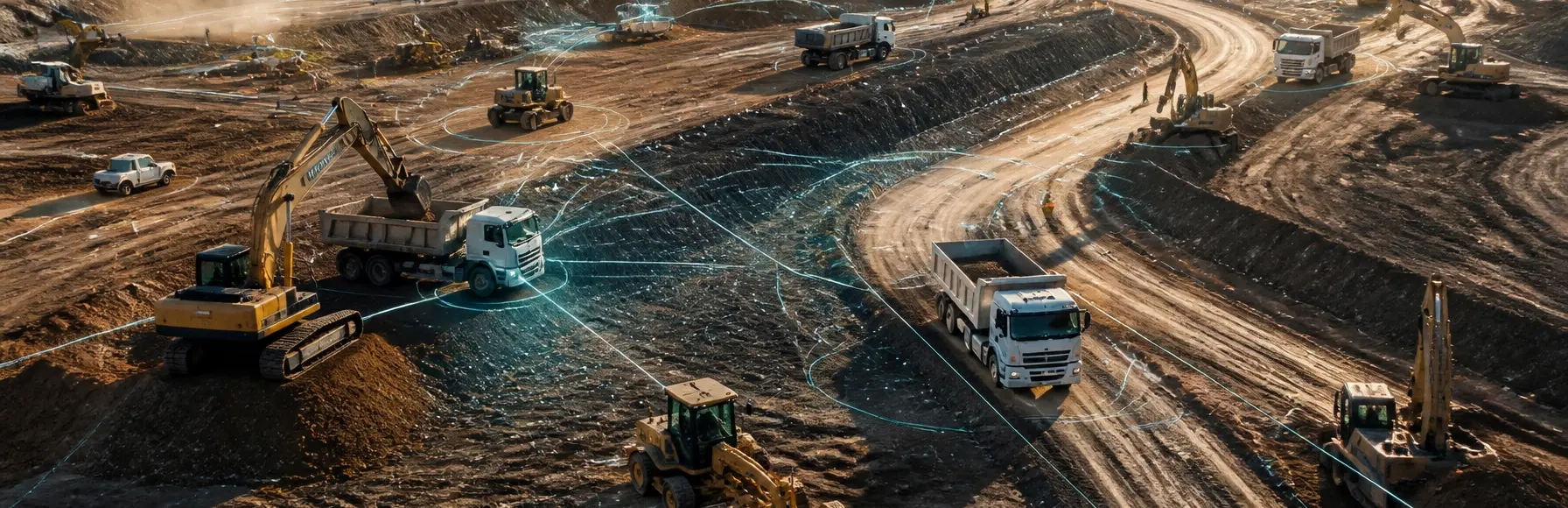
Are you actually managing your fleet, or are you just watching dots crawl across a screen?
If you’re running a local council or a major civil construction firm in Australia, you know the stakes. You aren’t just moving boxes from A to B. You’re managing multi-million dollar assets, coordinating complex service schedules, and most importantly, ensuring the safety of your people and the public.
The “dots on a map” era of fleet tracking in Australia is over. By 2026, the technology that keeps the biggest fleets moving has evolved into something far more intelligent. It’s no longer about where your excavator is; it’s about how it’s being used, when it’s going to break, and whether it’s about to put a ground worker at risk.
If your current gps fleet management system isn’t saving you money on maintenance or preventing accidents before they happen, alarm bells should be ringing. Let’s dive into the “secrets”: the specific tech stacks that high-performing councils and construction firms are using to stay ahead of the curve.

Is your heavy machinery working for you, or against you?
In civil construction, your “yellow plant”: excavators, loaders, and graders: is your biggest investment. But how often are they sitting idle? Or worse, how often are they being run into the ground because “the job needs to get done”?
Modern fleet telematics systems have moved beyond simple GPS. Leading Australian firms now use advanced asset tracking that integrates directly with the machine’s CAN-bus. This gives you a real-time health check on everything from engine hours to hydraulic pressure and fuel consumption.
When you can see that a 20-tonne excavator has been idling for 40% of its shift, that’s not just a statistic: that’s a direct hit to your bottom line. By right-sizing your fleet based on actual utilization data, many firms are finding they can achieve the same productivity with 15% fewer assets.

Can route optimization really solve the council “service juggle”?
For local councils, the challenge is different but equally complex. You have waste trucks, mowers, and maintenance utes crisscrossing the LGA every single day. The “secret” here isn’t just finding the shortest path; it’s about dynamic scheduling.
Are your service vehicles spending more time in traffic than on the tools?
Advanced route optimization tools take into account more than just distance. They factor in school zones, peak hour congestion, and even bin-collection weights to ensure your teams are working as efficiently as possible. This doesn’t just save fuel (though it does plenty of that); it increases your service levels. When you can hit more sites in a single shift, the community notices.
Furthermore, with the shift toward small electric trucks in councils, range anxiety is a real concern. Intelligent routing ensures your EV fleet is utilized on paths that match their battery capacity and charging cycles, making the transition to green energy “business as usual” rather than a logistical nightmare.
The safety “shield”: AI and thermal imaging
Safety is where the biggest technological leaps have occurred. In a busy construction site or a crowded council park, “I didn’t see him” is never an acceptable excuse.
We are seeing a massive shift toward video telematics for construction fleets. This isn’t about “spying” on drivers; it’s about providing them with a 360-degree safety shield. Systems like MyFleet’s Proxicam use AI-powered pedestrian detection to alert operators the millisecond a person enters a danger zone.

Think about the value of thermal imaging in low-visibility environments: dawn starts, dusty sites, or underground works. These sensors “see” the heat signature of a worker or a civilian long before the human eye can. This technology is becoming a standard requirement in government tenders. If you don’t have it, you might find yourself locked out of the biggest projects in the country.
Maintenance: Are you waiting for the “bang”?
Reactive maintenance is the silent killer of profitability. When a critical piece of machinery fails on-site, the “cost” isn’t just the repair bill. It’s the idle crew, the delayed project milestones, and the potential late-delivery penalties.
The “secret” of the biggest fleets is predictive maintenance. Instead of servicing a vehicle every six months regardless of its condition, leading firms use telematics to monitor real-time wear and tear.
Is the engine running hotter than usual? Is there a subtle drop in transmission pressure? These are the early warning signs that a breakdown is imminent. By scheduling maintenance before the failure occurs, you can turn a catastrophic breakdown into a managed, 2-hour pit stop.

Why your data is your best tender advantage
If you’re a civil contractor, you know that winning government work is getting harder. Councils and state departments are now looking for more than just a low price; they want to see your ESG (Environmental, Social, and Governance) credentials.
Can you prove your fleet’s carbon footprint? Can you demonstrate a proactive safety culture with hard data?
Using a unified fleet management software allows you to pull all these metrics into a single report. Showing a potential client that you have reduced idling by 20% and have a zero-incident safety record backed by AI video data isn’t just good practice: it’s a massive competitive advantage.
Connecting the remote corners of Australia
What happens when your fleet moves beyond the reach of the 5G network? For many civil construction firms working on infrastructure projects in regional NSW, Queensland, or WA, “black spots” are a constant headache.
This is where the combination of Starlink and telematics is changing the game. By using satellite-connected telematics, you can maintain a live data link to your assets no matter how remote the job site is. This ensures that safety alerts, duress signals, and engine diagnostics are always active, keeping your remote workers safe and your assets accounted for.

Is it time to level up?
Managing the biggest fleets in Australia isn’t about having the most vehicles; it’s about having the most intelligence vehicles. Whether you’re a council looking to improve service delivery or a construction firm aiming to tighten your margins and boost safety, the technology is now here to make it happen.
The question is: are you ready to stop just “tracking” and start truly managing?
If you want to see how these “secrets” can be applied to your specific fleet, it might be time for a chat. We’ve helped some of Australia’s largest organizations transition from basic GPS to a fully integrated, data-driven operation.
Don’t leave your fleet’s performance to chance. Contact MyFleet today and let’s build a tech stack that actually works for your business.