
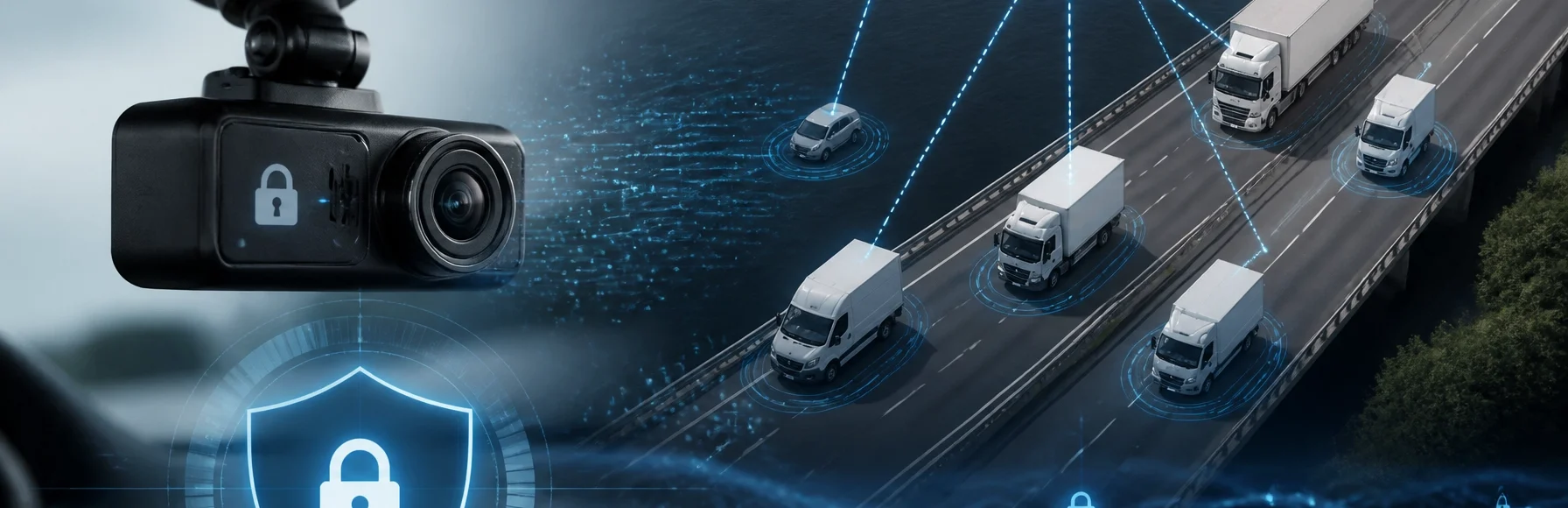
When you installed dashcams across your fleet, you probably did it for the right reasons: to protect your drivers, reduce insurance premiums, and have a “silent witness” in the event of an accident. But have you ever stopped to ask who else might be watching that footage?
It is imperative that was inadvertently broadcasting live camera feeds and GPS locations of its users to the public. Drivers were being heard having private conversations, and their exact movements were visible to anyone with the app.

If your fleet is your livelihood, this isn’t just a “tech glitch”: it’s a catastrophic business risk. Is your current provider treating your data like a vault, or are they leaving the back door wide open?
Are You Unwittingly Broadcasting Your Fleet’s Every Move?
Some “cloud-connected” systems were designed with convenience in mind, but security as an afterthought. Imagine a competitor knowing exactly where your high-value cargo is in real-time, or a malicious actor listening in on your driver’s cab conversations.
For a fleet manager or a business owner, the implications are massive. Beyond the creepy factor, you are looking at potential breaches of the Australian Privacy Act, massive fines, and a total loss of trust from your employees. When security fails, the “safety tool” you bought suddenly becomes your biggest liability.
At MyFleet, we’ve always believed that video telematics should protect you, not expose you. That’s why we take a “security-first” approach that goes far beyond the industry standard.

Can Your Data Survive an Interception?
When we talk about security, the first line of defense is encryption. Think of encryption as a high-tech shredder that turns your video and GPS data into unreadable gibberish for anyone who doesn’t have the “key.”
Many off-the-shelf dashcams store footage on a simple SD card in plain format. If that card is stolen, or if the data is intercepted while being uploaded to the cloud, it’s game over. Someone else has your footage.
Why encryption at rest and in transit is a non-negotiable
To be truly “worth their salt” in 2026, a telematics provider must secure data at two critical points:
- In Transit: As the video travels from the vehicle’s camera over the 5G or satellite network to the cloud, it must be shielded. We use robust, enterprise-grade encryption protocols to ensure that even if a hacker “sniffs” the data mid-air, they get nothing but noise.
- At Rest: Once the footage hits the servers, it shouldn’t just sit there in a folder. It must be encrypted while stored. This ensures that even if a server were compromised, the raw files remain protected.
If your current provider can’t explain their encryption standards in plain English, alarm bells should be ringing.
Who Exactly Has the Keys to Your Video Vault?
In a professional fleet environment, not everyone needs to see everything. Does your mechanic need to see the live cabin feed of a long-haul driver? Does a junior dispatcher need access to historical footage from six months ago? Probably not.

Is your access “Role-Based” or “Free-for-All”?
We implement strict Role-Based Access Controls (RBAC). This means you can define exactly what each user in your organization can see and do.
- Admins might have full access to everything.
- Safety Managers might only see footage triggered by a “harsh braking” event.
- Drivers might only have access to their own performance scores without seeing the raw video of their peers.
By locking down access based on specific security parameters, you drastically reduce the “insider threat” and ensure that private data stays private.
How Do You Stay on the Right Side of Australian Law?
The Australian Privacy Principles (APPs) aren’t just suggestions; they are legal requirements for most businesses. If you are recording video and audio of your employees or the public, you are collecting “personal information.”
Under APP 11, you are required to take “reasonable steps” to protect that information from misuse, interference, loss, and unauthorized access. If you choose a dashcam provider with known security holes, are you still taking “reasonable steps”?
The My Fleet commitment to compliance
We don’t just supply fleet camera systems; we provide a compliance framework. We help you ensure that:
- Data Sovereignty: Your data is stored in secure, Australian-compliant environments.
- Retention Policies: Footage is only kept as long as it’s needed, then automatically and securely deleted.
- Transparency: We provide the tools you need to notify your drivers and staff about what is being recorded and why, keeping you aligned with workplace surveillance laws.
Why the “Cheapest Option” Often Costs the Most
It’s tempting to look at a $200 dashcam from a retail store and compare it to a professional video telematics solution. On the surface, they both record video. But as the recent security scares have shown, the difference lies in what you can’t see.
A cheap system is often built on a generic software platform shared by thousands of other companies. If one gets hacked, they all get hacked. A professional system like ours is a closed loop, built for high-security environments like government, civil construction, and heavy transport.
The real cost of a security breach
If your fleet’s data is leaked, the costs aren’t just financial:
- Legal Fees: Defending privacy breach lawsuits.
- Fines: Regulatory penalties for failing to protect personal data.
- Reputational Damage: Losing contracts because your clients no longer trust your operational security.
- Staff Turnover: Drivers leaving because they feel their privacy has been violated.
When you weigh these against the cost of a secure system, the choice becomes clear. Security isn’t a luxury; it’s a foundation of modern business.

Is Your Fleet Prepared for the Future?
As we move further into 2026, the amount of data your vehicles generate will only grow. With the rise of AI-powered fleet business insights, your cameras aren’t just recording video; they are analyzing behavior, fatigue, and environmental hazards.
This data is incredibly valuable. It’s the “black box” of your business operations. You wouldn’t leave your physical office unlocked overnight, so why would you leave your digital fleet data unprotected?
Take Control of Your Fleet Security Today
You’ve worked hard to build your business and your reputation. Don’t let a sub-standard camera system put it all at risk.
If you’re unsure about the security of your current setup, or if you’re looking to upgrade to a system that takes privacy as seriously as you do, let’s have a conversation. At My Fleet, we don’t just sell hardware; we provide peace of mind.
Ready to secure your fleet?
- Explore our secure Fleet Camera Systems
- Talk to our experts about a security audit for your telematics
- Learn more about our commitment to your privacy
Don’t wait for a headline to tell you your data is at risk. Be proactive, stay secure, and keep your fleet moving forward.