
What happens when you open a harsh braking event, a fatigue alert or a speeding incident, and your fleet tracking system cannot tell you who was behind the wheel?
Was it the regular driver? A relief driver? A subcontractor? Someone moving the truck around the depot?
If you cannot answer “who was actually driving?”, how much confidence can you place in the rest of your data?
This quiet gap affects far more than a single trip record. It can undermine fatigue monitoring, driver behaviour scores, incident investigations, coaching conversations, insurance claims and your Chain of Responsibility evidence.
The problem is usually not a lack of data. It is a missing link between the vehicle and the driver.
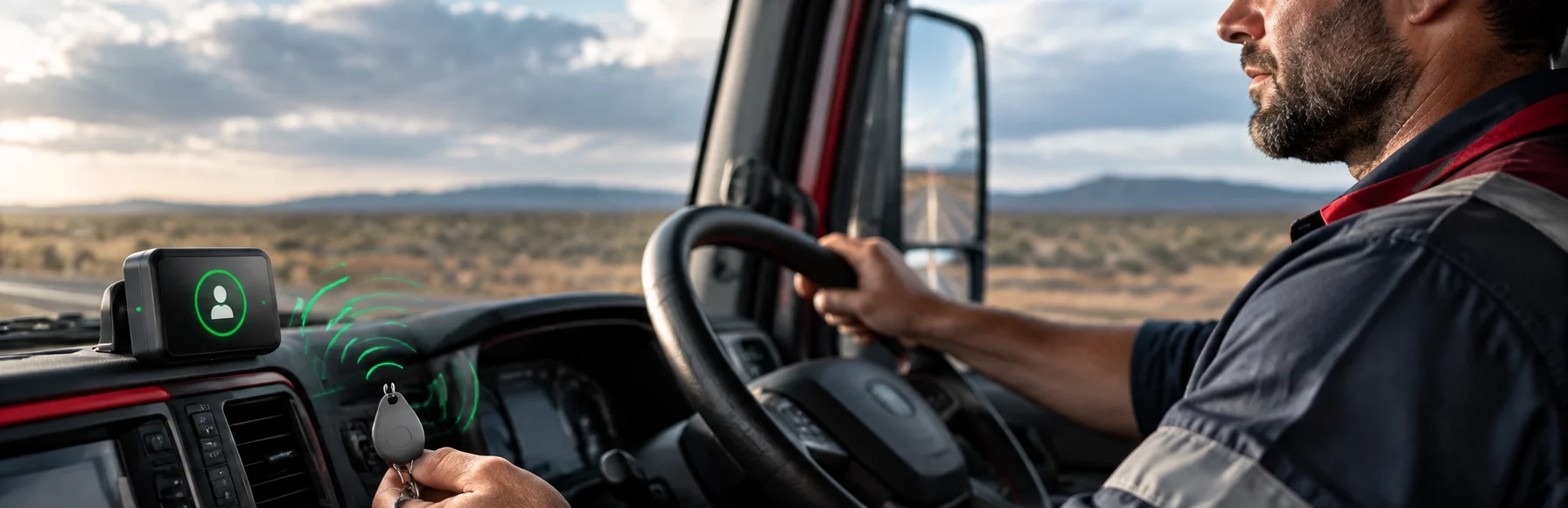
Automatic Bluetooth Low Energy (BLE) driver identification closes that link at the source.

Is your fleet data tied to the right person?
An unassigned trip occurs when a vehicle moves, but your fleet telematics platform cannot confirm which driver was operating it.
In practice, this happens more often than many fleet managers realise.
A truck moves around the yard while a mechanic checks it. A casual driver takes over from the regular operator. A subcontractor arrives to complete a delivery. Two drivers share one vehicle across different shifts. A relief driver forgets to enter a PIN or sign in through an app.
The vehicle is moving. GPS fleet management records the movement. But the driver field is blank, or worse, it shows the wrong person.
Manual sign-on processes create the gap because they rely on one more task for a busy driver to remember.
Drivers may be dealing with pre-start checks, load instructions, delivery paperwork, changing vehicles and tight schedules. If signing in takes several steps, it is easy for the process to be skipped, delayed or completed against the wrong vehicle.
The consequences include:
- Trips appearing under the wrong driver’s name
- Missing or incomplete work and rest records
- Fatigue events that cannot be reliably attributed
- Driver scorecards that penalise the wrong person
- Delays when reconstructing an incident
- Time-consuming administration to allocate trips manually
- Coaching conversations where the driver does not trust the data
That last point matters. Driver behaviour technology only works when your people believe the information is accurate and fair.

Why does this matter more under the 2026 compliance environment?
From 1 August 2026, the amended Heavy Vehicle National Law places renewed focus on fatigue management, record keeping and the way transport safety risks are managed.
The National Heavy Vehicle Regulator’s guidance on work diaries confirms that eligible drivers may use an Electronic Work Diary (EWD) as an alternative to a Written Work Diary. The record must still provide an accurate account of work and rest.
That means the quality of your EWD data depends partly on the quality of the driver sign-on attached to it.
If a vehicle moves without a confirmed driver, you may have a work record, but not a reliable person-to-record connection.
An unassigned trip is therefore more than an annoying data gap. It is a hole in the evidence you may need to show that you identified, monitored and acted on fatigue risk.
This is relevant to everyone involved in the Chain of Responsibility. Operators, schedulers and managers need to understand whether a run is achievable, whether work and rest records are accurate and whether the right person receives follow-up when a risk occurs.
A correct driver-to-vehicle link does not, by itself, prove that you have met every primary duty obligation. Work and rest compliance is not the same as proving a driver is fit to drive. You still need appropriate scheduling, supervision, training and fatigue controls.
But without knowing who was driving, your ability to demonstrate those controls becomes much weaker.
How does automatic Bluetooth driver identification work?
The principle is straightforward.
Each driver receives a small BLE credential. It may be a tag, fob, card or approved smartphone-based identity. The credential is linked to that driver’s profile in your fleet tracking platform.
When the driver approaches or enters the vehicle, the in-cab telematics device detects the BLE signal. The system then assigns the driver to the vehicle and the relevant trip automatically.
There is no PIN to remember. No app screen to find. No separate sign-on process to complete before moving the vehicle.

When the driver leaves, the system can unassign the driver or record the end of that driver’s vehicle use, depending on the configuration.
If a vehicle moves without detecting an authorised credential, the movement can be flagged as an exception for review.
That changes the operating model. Instead of treating missing driver data as normal, you treat it as something that needs attention.
How does BLE compare with other identification methods?
Manual PINs and app sign-ons can work, but they depend on the driver completing the process every time.
Swipe cards and key fobs reduce some friction, but they can be shared, swapped or left in the vehicle.
Camera-based facial recognition can provide a stronger identity check and has a place in some in-cab safety systems. However, it generally involves more hardware, greater implementation complexity and additional privacy considerations.
BLE driver identification is attractive because it is automatic, relatively low cost and simple to operate. It removes the human step that creates many unassigned trips.
There is an important accuracy nuance, however. BLE identifies the presence and proximity of the assigned credential. It does not independently prove that a particular person is physically holding the tag or that nobody else entered the cab.
For standard trip attribution, BLE can be highly effective. For higher-assurance use cases, you can layer BLE with an in-cab camera, PIN confirmation, ignition control or another defined verification step.
What changes when every trip has a driver attached?
The biggest benefit is not another dashboard feature. It is more trustworthy information throughout your operation.
With automatic driver identification, you can work towards:
- Every trip being attributed to a named driver
- More accurate work and rest records
- Better fatigue monitoring and exception management
- Fairer driver behaviour scoring
- More focused coaching conversations
- Faster incident reconstruction
- Clearer insurance and exoneration evidence
- Stronger audit trails for CoR and WHS processes
- Less administration chasing drivers to sign on
- Better visibility of relief, casual, agency and subcontractor drivers
It can also support access control.
If your configuration allows it, you can restrict vehicle start or operation to authorised drivers. That may be particularly useful for high-value vehicles, heavy equipment, mine-site operations or vehicles requiring specific licences and competencies.

The operational difference becomes clear during an incident.
Instead of starting with, “We think this vehicle was being driven by…”, you can begin with a verified trip assignment, time, location and vehicle history.
That gives your manager, safety team, insurer or investigator a much stronger starting point.
What should you look for in a driver identification system?
Not every Bluetooth solution delivers the same result. Before choosing a system, ask practical questions.
Does it work without a manual step?
The purpose of automatic identification is to remove friction. If drivers still need to press a button or sign in manually for every trip, you may not be solving the original problem.
Can it handle multiple tags nearby?
A vehicle may be parked near a depot, workshop or group of drivers. Your system should have a clear method for determining which credential is inside or closest to the cab, and it should flag uncertain situations rather than silently assigning the wrong person.
Does it integrate with your existing telematics?
Driver identification is most valuable when it connects with your GPS fleet management, fatigue records, driver scoring, video events and reporting. Avoid creating another isolated database that requires manual reconciliation.
Are the tags suitable for your operating environment?
Mining, civil construction, waste and transport operations can be hard on equipment. Check durability, water resistance, battery life, replacement costs and how quickly a lost tag can be disabled and replaced.
Can you see the exceptions?
A good system should show unassigned trips, missing credentials, overlapping detections and other exceptions. The aim is not to pretend that gaps will never happen. It is to make them visible and easy to resolve.
Can you add stronger verification later?
You may only need automatic BLE attribution today. However, you may later want to combine it with video telematics, a PIN, immobilisation or other access controls.
Is there Australian support?
Installation, training and ongoing support matter. Your system should be practical for your drivers and supported by people who understand Australian fleet operations and compliance requirements.
How can My Fleet help close the gap?
My Fleet brings driver identification together with GPS tracking and telematics, video telematics, asset tracking and cold-chain monitoring in one platform.
You can also explore our Driver ID solution and telematics software to see how driver data can connect with vehicle activity, safety events and operational reporting.
The objective is simple: close the data gap at the source so the rest of your telematics is more trustworthy.
With the right configuration, automatic BLE identification can reduce manual sign-on, improve visibility of shared vehicles and help your team distinguish genuine exceptions from routine fleet movements.
My Fleet also provides local support and Australian-based technicians to help with installation and implementation.
Can your fleet answer the most basic question?
Telematics can tell you what the vehicle did.
It can show where the vehicle travelled, how fast it moved, whether it braked harshly and when an event occurred.
Driver identification tells you who did it.
Without that link, your fatigue records, driver scorecards, incident reviews and compliance evidence may all be built on assumptions.
Start with a simple review: check how many unassigned trips your fleet recorded this month.
Then ask why they occurred, which vehicles and drivers are most affected, and what those gaps could mean for your next audit or incident investigation.
If the number is higher than you expected, automatic Bluetooth driver identification may be the practical next step. Talk to My Fleet about connecting driver identity with the rest of your fleet telematics.