
What would one blown tyre cost your transport business?
Not just the tyre. Not just a roadside callout. What happens if a wheel-end fire destroys the trailer, damages the prime mover and wipes out a $250,000 load belonging to your customer?
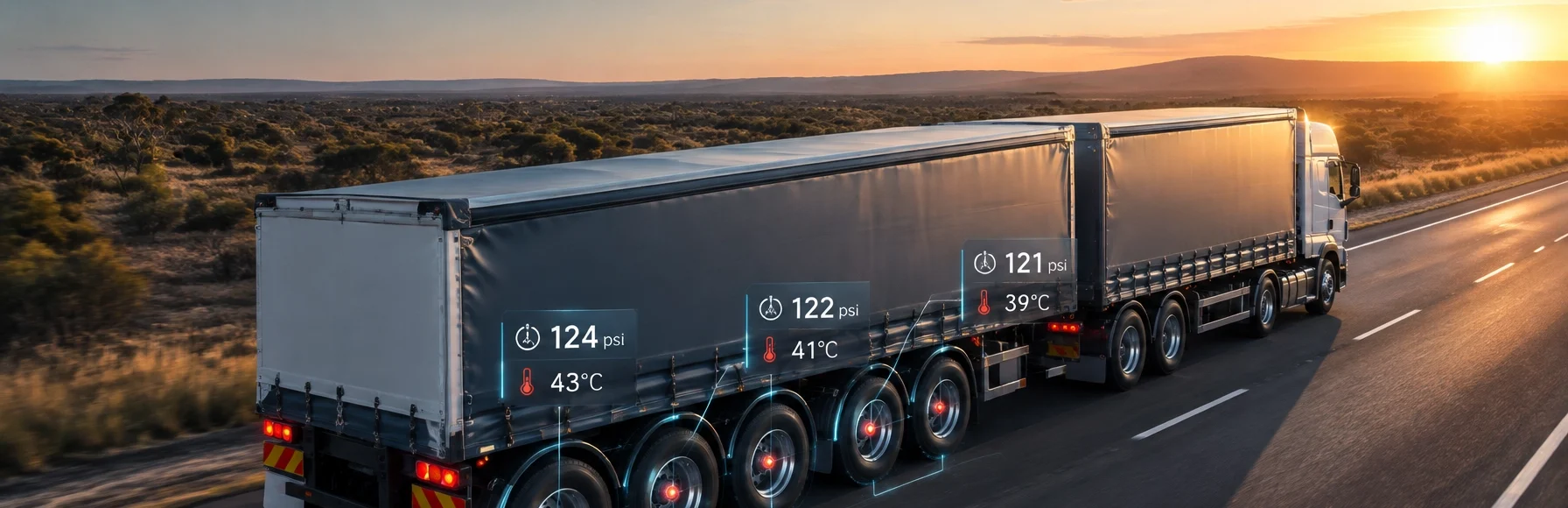
For Australian freight and transport operators, tyre pressure monitoring systems (TPMS) provide an important layer of protection. They give you visibility of pressure and temperature at every monitored wheel position while your vehicle is moving: helping you identify problems before they become breakdowns, fires, lost freight or serious Chain of Responsibility concerns.
The financial case is straightforward: a TPMS installation costs a fraction of a major tyre-related incident.

What does a tyre pressure monitoring system actually do?
What would one blown tyre cost your transport business?
Not just the tyre. Not just a roadside callout. What happens if a wheel-end fire destroys the trailer, damages the prime mover and wipes out a $250,000 load belonging to your customer?
For Australian freight and transport operators, tyre pressure monitoring systems (TPMS) provide an important layer of protection. They give you visibility of pressure and temperature at every monitored wheel position while your vehicle is moving: helping you identify problems before they become breakdowns, fires, lost freight or serious Chain of Responsibility concerns.
The financial case is straightforward: a TPMS installation costs a fraction of a major tyre-related incident.
What does a tyre pressure monitoring system actually do?
A TPMS uses sensors fitted to each monitored wheel position. Depending on the system, sensors can be installed:
- Inside the tyre
- Externally on the valve stem
- On a trailer or wheel-end assembly
The sensors transmit live or near-real-time information about:
- Tyre pressure
- Tyre temperature
- Pressure changes
- Rapid leaks
- Abnormal heat at the wheel end
That information is sent to a display in the cab, fleet dashboard or telematics platform. If pressure falls or temperature rises beyond a defined threshold, you receive an alert.

This is different from a TPMS+R or tyre pressure refill system.
A standard TPMS detects and reports a problem. A TPMS+R system can also add air or support automatic pressure correction, depending on its design. Both can help manage tyre risk, but they are not interchangeable. You should understand whether your system is providing monitoring only or active pressure management.
Why are manual tyre checks not enough for freight fleets?
Underinflation is often invisible.
A tyre can lose around 20% of its pressure before it looks obviously flat. By then, it may already be flexing excessively, generating heat and wearing irregularly. Your driver may not see the problem during a walk-around check, particularly on an inner dual tyre or a trailer wheel position that is difficult to inspect.
A depot inspection also only tells you what is happening at that moment.
A slow leak can develop after the vehicle leaves the yard. A valve can fail halfway through a route. A hot bearing can transfer heat into the wheel. A dragging brake can gradually raise the temperature of the entire wheel-end assembly.
Your driver may only discover the issue when the tyre fails.
That is why manual inspections and TPMS work best together. Manual checks remain essential, but TPMS gives you continuous monitoring between inspections and during the journey.
For a B-double or semi-trailer travelling hundreds of kilometres, that additional visibility can make a significant difference.
What is the real cost of losing a trailer load?
Consider a realistic freight scenario.
Your semi-trailer is carrying high-value consumer electronics, pharmaceuticals, alcohol, retail stock or machinery. The freight belongs to your customer, but your business is responsible for transporting it safely.
The load is worth $220,000.
A tyre begins to run underinflated. Heat builds at the wheel end. The driver receives no warning, because the problem is not visible and the next manual check is still hours away.
The tyre fails. The failure damages the wheel assembly and starts a fire.
Here is how the cost can build:
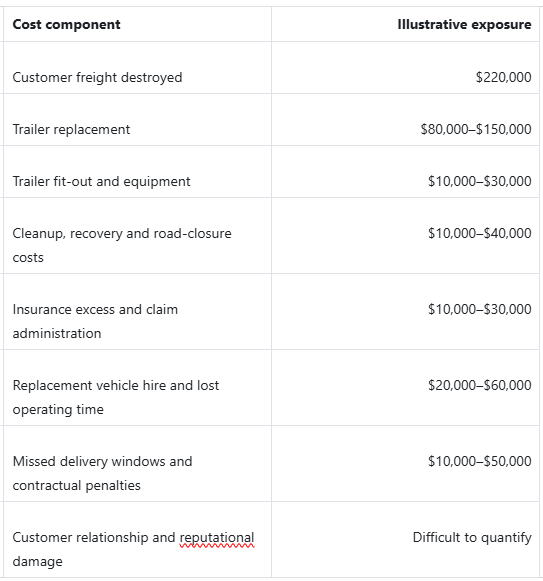
That is already potentially more than $500,000 from one event.
If the fire spreads to the prime mover, you may need to add $250,000 or more for the vehicle, along with additional downtime, recovery and insurance costs.
The exact total depends on your freight, policy, contracts and fleet structure. But the central point is clear: losing one trailer load can create a financial exposure that is many times greater than the cost of monitoring the tyres.
And the freight may not even belong to you. You can still face claims, investigations, contract consequences and the loss of a valuable customer.
How common are wheel-end fires and tyre failures?
This is not a theoretical risk.
The NTARC/NTI Major Incident Report 2024 identifies wheel-end fires as the most common cause of non-impact heavy vehicle fires. The report also shows that non-impact fire incidents rose from 5.45 per 10,000 heavy vehicle powered units in 2021 to 10.8 per 10,000 in 2023.
That is almost double the rate.
Wheel-end fires are also almost twice as common at trailer wheel ends as at powered-unit wheel ends. That matters because trailer wheels can be further from the driver’s immediate attention and may carry a significant portion of the load.
Australian industry data cited in the report indicates:
- Tyres are the source of approximately 46.5% of wheel-end fires
- Bearings account for approximately 25%
- Brakes account for approximately 14.3%
- Around 61.3% of wheel-end fires are initiated at the tyre or wheel
- Roughly 35% of truck and trailer fire incidents trace back to tyre and wheel failures
- The historical average fire loss is approximately $170,129
These numbers describe average or reported losses: not the maximum exposure of a high-value freight load. A trailer carrying pharmaceuticals, electronics or other time-sensitive goods can create a much larger claim.
Can TPMS identify a problem before a blowout?
It can identify warning signs that a manual inspection may miss.
A pressure alert can indicate:
- A puncture or slow leak
- A damaged valve
- A failing tyre
- An overloaded or incorrectly inflated wheel position
- A pressure imbalance across dual tyres
A temperature alert can help reveal:
- Excessive tyre flex
- A hot bearing
- A dragging brake
- Abnormal heat at a wheel end
- A developing failure after extended highway travel

TPMS does not make your tyres, bearings or brakes fail-proof. It does not replace driver inspections, correct loading, tyre maintenance or scheduled servicing.
What it does is give you an earlier warning. Instead of finding a failure after it has damaged the trailer, you have an opportunity to stop safely, investigate the alert and prevent a much larger event.
That difference is where the financial value sits.
How much can underinflated tyres cost you every day?
The cost of tyre pressure problems is not limited to catastrophic fires.
Underinflation increases rolling resistance and causes the tyre to flex more than it should. That creates heat, accelerates wear and increases fuel use.
Depending on the tyre, vehicle and operating conditions:
- Around 5% underinflation can increase fuel consumption by approximately 0.5%
- Around 10% underinflation can increase fuel consumption by approximately 1–2%
- Chronic underinflation can reduce tread life by up to 25%
- Correct pressure can extend tyre life by approximately 15–30%
For a freight fleet, even a small percentage matters.
If one vehicle uses $60,000 of fuel each year, a 1% avoidable fuel penalty represents approximately $600 per vehicle annually. Across 50 vehicles, that becomes $30,000 per year.
Now add premature tyre replacement, roadside callouts, technician time and vehicle downtime. A TPMS system can pay for itself through everyday operating savings, before you even account for the cost of avoiding a major incident.
For many operators, a realistic payback period is less than one year to three years, depending on fleet size, tyre costs, fuel use and the number of monitored wheel positions.
What else can TPMS improve across your operation?
When integrated with fleet tracking and fleet telematics, TPMS can support more than a driver alert.
You can use tyre data to help you:
- Reduce roadside breakdowns and emergency callouts
- Identify slow leaks before they become failures
- Reduce premature tyre replacements
- Improve fuel efficiency
- Reduce manual pressure-checking labour
- Create stronger maintenance records
- Investigate recurring tyre, bearing or brake issues
- Protect dangerous goods and high-value freight
- Demonstrate active risk management under Chain of Responsibility
The important factor is follow-through. An alert only creates value when your team has a clear process for responding to it.
Your procedure should define who receives the alert, when the driver must stop, who checks the vehicle and how the rectification is recorded.
Does TPMS help with compliance and Chain of Responsibility?
The NHVR’s 2026 Master Code of Practice strengthens the focus on documented risk management across heavy vehicle operations. It does not mean that every Australian heavy vehicle is legally required to have TPMS, nor does it create a blanket requirement to comply with UN ECE R141.
However, it does reinforce the need for operators and other Chain of Responsibility parties to identify hazards and apply reasonably practicable controls.
Tyres, wheel ends, brakes, loading and vehicle maintenance are all part of that risk picture.
A TPMS can support your safety management system by providing evidence that you are actively monitoring a known heavy vehicle risk. Systems aligned with the performance principles of UN ECE R141 also give you an internationally recognised benchmark for pressure monitoring and alert performance.
Industry is continuing to discuss whether Australia should move towards requirements aligned with UN ECE R141. By adopting effective monitoring now, you can get ahead of future expectations rather than waiting for a serious incident or regulatory change.

Why connect TPMS with your existing fleet technology?
A separate tyre monitoring screen can create another silo for your team.
The stronger approach is to connect TPMS with the systems you already use for:
- GPS fleet tracking
- Fleet tracking and management
- Video telematics
- BLE asset and trailer tracking
- Cold-chain monitoring
- Maintenance and compliance records
My Fleet can help you bring these data sources into one platform. That means your team can see where the vehicle is, how it is being driven, what the cameras recorded and whether a tyre is losing pressure or gaining temperature.
For an Australian freight operator, one connected view is easier to manage than separate tools, spreadsheets and manual phone calls.
Is TPMS worth it for your fleet?
If you operate a semi-trailer, B-double, refrigerated vehicle, dangerous goods fleet or high-value freight operation, the question is not whether tyre failures are possible.
The question is whether you want to know about a problem while you can still do something about it.
The cost of losing a trailer load can quickly exceed $500,000, and a wider fire involving the prime mover can push the exposure substantially higher. Against that risk, a quality TPMS installation is a practical engineering control that can also reduce fuel consumption, tyre wear and unplanned downtime.
Start by reviewing your highest-risk trailers and wheel positions. Identify the freight that would create the greatest financial or customer impact if lost. Then speak with your fleet technology provider about integrating TPMS with your existing fleet telematics systems.
Contact MyFleet to discuss how TPMS, GPS fleet tracking, video telematics and trailer monitoring can work together in one platform: with Australian-based support and technicians.