
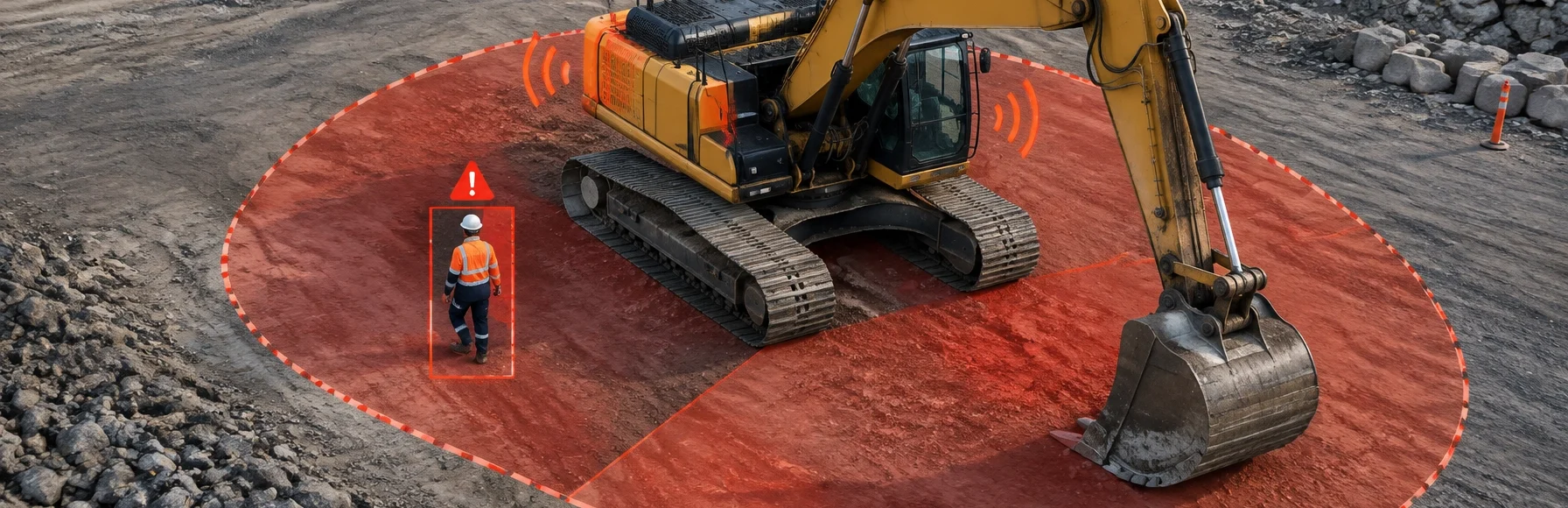
What happens when a person enters the blind spot of an excavator, loader or mobile processing unit, and the operator is looking in the other direction?
A camera may show the person. But unless the operator is watching the correct screen at the exact moment, the risk remains.
The Regulator is examining mobile plant coordination, communication protocols, contractor management and the practicability of proximity detection and collision avoidance technology.
The human cost is devastating. The wider lesson is clear: blind spots around heavy plant remain a systemic risk, even when cameras and spotters are in place.

Why are blind spots still a major workplace risk?
Heavy plant creates blind spots by design.
An excavator’s boom, counterweight and cab structure can block the operator’s view. A loader’s bucket can hide a person directly in front of the machine. A dozer, skid steer, tipper or mobile processing unit can have large areas where a worker is completely invisible from the operator’s seat.
The risk changes as the machine moves. An excavator’s swing arc can shift from clear to occupied in seconds. A worker crouching beside a machine may be below the operator’s natural sightline. Dust, terrain, stockpiles, attachments and other vehicles can further obstruct visibility.
Safe Work Australia recorded 312 worker fatalities from being hit by moving objects between 2003 and 2012. Mobile plant and transport accounted for the majority of these incidents. Across the same period, mobile plant and transport were identified as the breakdown agency in 62% of worker fatalities.
The dedicated Safe Work Australia report on truck-related fatalities also recorded 18 worker deaths involving reversing trucks at workplaces during that decade. Of the 54 pedestrian workers killed in truck-related incidents away from public roads, one-third involved a reversing truck.
These are historical figures, but the hazard has not disappeared. Mobile plant is still used on busy, changing worksites where operators, contractors, visitors and other vehicles share the same operating zones.
Why can’t a camera solve the problem on its own?
A conventional camera is a visibility tool. It displays an image. It does not automatically understand what the image means, warn a worker or intervene in the machine’s movement.
The operator must:
- Look at the correct screen.
- Notice the person.
- Interpret the person’s position and direction.
- Understand how the machine is moving.
- Decide what action to take.
- React before the machine reaches the person.
That is a lot to ask during a complex operating cycle.
An excavator operator may be managing the boom, bucket, swing, load, ground conditions, grade, radio traffic and instructions from the crew, all at once. Split attention is not an unusual part of the job. It is the job.
Adding more camera views can improve coverage, but it can also increase the amount of information competing for the operator’s attention. The operator cannot continuously monitor every screen for an entire shift without a drop in vigilance.

A camera also does not reliably differentiate a person from a post, shadow, cone, rock or item of equipment at range. Mud, dust, rain and vibration degrade lenses and screens. Sun glare can wash out an image. Night work and low light reduce the usefulness of a basic camera view even further.
And when a near miss occurs, a camera-only system may provide no automated alert, no event trigger and no structured data for review.
The result is a control that depends heavily on perfect human attention in an environment where perfect attention is unrealistic.
What changes when detection becomes active?
The safety shift now taking place is from “see it” to “detect it and intervene.”
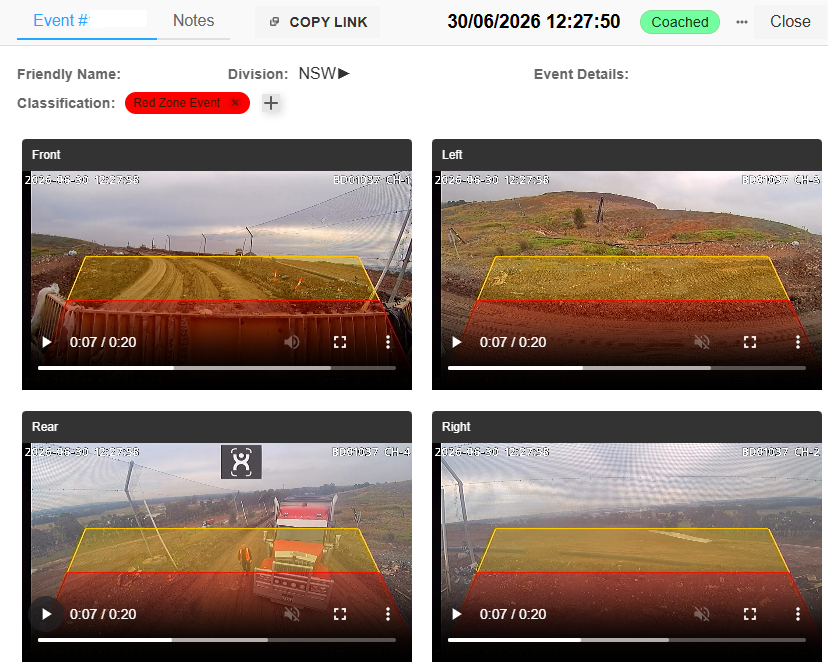
AI computer vision systems actively analyse camera feeds and classify what is in the machine’s operating zone. Instead of simply presenting footage, they can identify pedestrians and vehicles in real time and trigger an alert when a configurable zone is breached.
This matters on mixed worksites because workers do not necessarily need to carry RFID tags, Bluetooth beacons or specialised clothing. Contractors, subcontractors, delivery drivers and visitors can enter a site without being added to a tag system. Tag-free detection removes one practical gap in protection.
A properly configured system can provide:
- Multi-camera 360-degree coverage around the machine
- Warning, caution and danger zones matched to the machine’s geometry
- Pedestrian and vehicle classification
- Immediate audible and visual alerts to the operator
- External alarms, lights or voice warnings for people on foot
- Local, edge-based processing for low-latency alerts
- Event logging and video recording for near-miss review
- Optional plant slow-down or stop functions in high-risk configurations
Latency is critical. An alert that arrives a second late is of little value beside a slewing excavator or reversing mobile processing unit. Processing detection locally on the machine reduces dependence on a remote server or mobile network.
Why does the WHS hierarchy matter?
Under the WHS framework, the hierarchy of controls ranks measures from most reliable to least reliable:
- Elimination
- Substitution, isolation and engineering controls
- Administrative controls
- Personal protective equipment
Safe Work Australia states that administrative controls and PPE are less effective because they rely on human behaviour and supervision.
A procedure saying “check the blind spot” is an administrative control. A spotter calling instructions is also an administrative control. High-vis clothing improves visibility, but it does not prevent a machine from entering an occupied zone.
A pedestrian-sensing or proximity detection system changes the plant itself. It can therefore form part of an engineering control, sitting higher in the hierarchy than relying on operator attention, radio calls or signage alone.
That distinction matters when an incident is investigated. Regulators will want to know not only what the procedure required, but whether the control was reliable, maintained, monitored and reasonably practicable for the risk.
The NSW Resources Regulator’s IIR26-05 specifically reminds mine operators to consider available proximity detection and collision avoidance technology, while also maintaining effective positive communication, spotter use and separation controls.
Is this only a mining issue?
No. The same risk appears wherever people and mobile equipment work together.
Tippers, water carts, rollers, loaders, sweepers, mobile crushers, screens, skid steers and trucks operate around pedestrians in civil construction, councils, quarries, waste facilities and infrastructure projects.
Plant also moves between sites. A fleet operator transporting excavators, loaders or attachments carries risk during loading, unloading, depot movements and site access, not just during the main project task.
That makes active detection relevant to both plant owners and transport operators. Your wider video telematics, fleet telematics systems and GPS fleet management platform can help connect machine events, location, footage and near-miss reporting.
What should you ask before choosing a system?
Before fitting a detection system, ask whether it:
- Detects people actively rather than simply displaying footage
- Uses AI to classify pedestrians and vehicles
- Supports configurable warning and danger zones around the whole machine
- Provides 360-degree or suitably comprehensive coverage
- Delivers audible and visual in-cab alerts
- Can warn pedestrians externally
- Processes alerts locally with low latency
- Works in dust, dirt, rain and low light
- Operates without requiring worker-worn tags
- Logs events and retains relevant video
- Integrates with your wider telematics platform
- Includes Australian installation, commissioning and technical support
You should also test the system on the machine and at the worksite where it will operate. Detection zones need to reflect the actual swing arc, attachment, counterweight, loading path and pedestrian interaction points, not a generic factory configuration.
What is the next step for your operation?
A camera shows your operator what they might have missed.
Detection technology helps make sure a person is never just something they might have missed.
My Fleet can help you bring pedestrian detection, video telematics, GPS tracking and fleet safety reporting together across your vehicles and mobile plant. With Australian-based technicians and support, you can assess the risk on your excavators, loaders, tippers, water carts and other heavy equipment, then build a layered control strategy around the way your team actually works.
Review your highest-risk machine first. Map its blind spots. Check how near misses are currently captured. Then speak with your safety and operations teams about adding active detection to the controls already in place.
Explore My Fleet’s fleet safety and compliance solutions, review integrated camera systems or contact My Fleet to discuss your requirements.