
![[HERO] Stop Wasting Time on Fragmented Tools: Why a Single Platform is the Secret to Modern Fleet Tracking](https://cdn.marblism.com/yLUQLKJUPh8.webp)
How many browser tabs do you have open right now? If you are managing a fleet in Australia today, the answer is likely “too many.” You might have one window for GPS location, another for fuel card reporting, a third for maintenance schedules, and a fourth: perhaps the most critical: for your video telematics feed.
Are you actually managing your fleet, or are you just managing your software?
For many fleet managers in civil construction, local councils, and transport companies, the “digital transformation” has unintentionally led to a “digital fragmentation.” We were promised that more data would lead to better decisions, but without a way to unify that data, most managers are simply drowning in noise.
In this guide, we will explore why moving to a single, integrated platform is no longer a luxury: it is the secret to survival in the modern landscape of fleet tracking and management.
Are You Paying a “Fragmentation Tax”?
Every time your team has to manually export a CSV file from one system to upload it into another, you are paying a fragmentation tax. It isn’t a line item on your P&L, but it is eating your margins nonetheless.
Fragmented fleet telematics systems create substantial operational friction. When you use multiple disconnected tools, you are dealing with multiple servers, complex communication patterns between apps, and the inevitable headache of data duplication. When the information in your maintenance log doesn’t match the odometer reading on your gps fleet tracker, which one do you trust?
This inconsistency breeds confusion. Different interfaces require extensive staff training, and disjointed processes prevent seamless information sharing across your organization. If your dispatch team isn’t seeing the same real-time data as your safety officer, you aren’t running one company; you’re running several small ones that happen to share a logo.

Why Does Data Fragmentation Kill Productivity?
It is easy to dismiss a few extra minutes spent logging into a different portal as “just part of the job.” But the numbers tell a different story. Research suggests that by eliminating manual check-ins and data entry across multiple systems, dispatchers can gain back 2 to 8 hours every single week.
Imagine what your team could do with an extra full day of productivity. Instead of acting as human bridges between software programs, they could focus on growth, customer service, and optimizing routes.
When you utilize a unified fleet telematics systems solution, you remove the need for manual coordination. Automated tracking and integrated workflows make important data readily available to all team members simultaneously. No more phone calls to drivers to ask for their location. No more “he said, she said” disputes over delivery times. The data is simply there, in one place, for everyone who needs it.
Is “Good Enough” GPS Fleet Management Costing You 25%?
Many businesses hold onto legacy systems because they believe the cost of switching is too high. However, the cost of staying put is often much higher. Fleets that transition to centralized fleet telematics systems report operational cost reductions of up to 25%.
How is that possible? It comes down to the elimination of waste:
- Fuel Savings: Unified platforms drive 20% to 30% fuel savings through optimized routing and aggressive idle-time monitoring.
- Maintenance Overhead: When your gps fleet management system is directly tied to engine diagnostics, you move from reactive repairs to proactive maintenance.
- IT Simplification: A unified platform requires easier maintenance. You deal with a single provider for upgrades, downgrades, and security patches, rather than managing a web of different security requirements and update schedules.

Why Visibility Isn’t Just About Dots on a Map
In the early days of fleet tracking, knowing where a truck was located was enough. Today, that is just the baseline. Modern gps fleet tracking needs to tell you the context of that location.
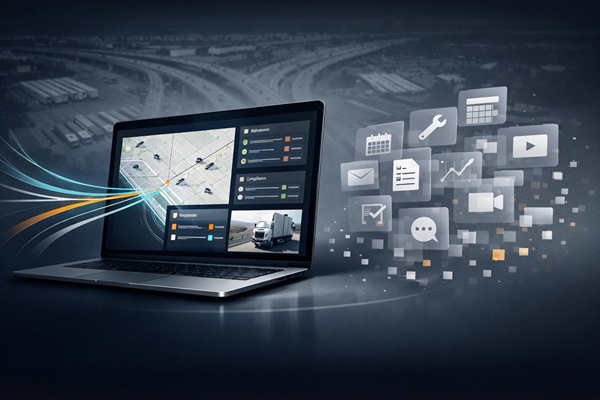
Is the vehicle idling because of traffic, or is the driver taking an unauthorized break? Is the heavy machinery on the civil site being used efficiently, or is it sitting active but unused? A single platform provides a “single source of truth” with one login. This gives you complete visibility into driver behavior, fuel consumption, and vehicle performance all from one dashboard.
For Australian councils and government bodies, this level of visibility is also about public accountability. Being able to provide a digital proof of service or an audit-ready trail of vehicle activity is essential for maintaining trust and meeting regulatory standards.
Is Video Telematics the Missing Link in Your Safety Chain?
If you are only looking at GPS data, you are missing half the story. Video Telematics is the bridge between “what happened” and “why it happened.”
Integrating live video feeds with your telematics data allows for real-time monitoring that GPS alone cannot provide. For example, in civil construction, the risk of pedestrian or worker injury is a constant concern. A unified platform like My Fleet allows you to see synchronized camera views with highlighted detection zones.
When a “near miss” occurs, a fragmented system might give you a GPS alert for harsh braking. A unified platform, however, will show you the video footage of the event, the speed of the vehicle, and the proximity of workers at that exact moment. This isn’t just about catching mistakes; it’s about exonerating drivers from false claims and building a culture of safety. You can learn more about how these systems integrate on our products page.
Better Decision-Making: Moving from Reactive to Proactive
The ultimate goal of any fleet manager gps tool is to help you make better decisions, faster. When data is consolidated, company leadership gains deeper insights.
Instead of looking at a report at the end of the month and wondering why fuel costs spiked, you receive real-time notifications on unsafe driver behavior or engine diagnostics. You can intervene now, before a small mechanical issue becomes a total engine failure, or before a lead-footed driver causes an accident.
This proactive approach is what separates a modern fleet from an outdated one. It changes the role of the fleet manager from someone who puts out fires to someone who prevents them from starting in the first place.

The Road Ahead: Consolidate or Fall Behind?
The “worth their salt” fleet managers of tomorrow are already moving toward consolidation. They recognize that the complexity of modern logistics: rising fuel costs, driver shortages, and tightening regulations: cannot be managed with a “patchwork” of tools.
If your current setup feels like a house of cards, the alarm bells should be ringing. The transition to a single platform isn’t just about new software; it’s about a new way of doing business. It’s about having the confidence that when you look at your screen, you are seeing the whole truth of your operations.
Stop wasting time on fragmented tools. The secret to modern fleet tracking isn’t more data: it’s better-integrated data.
Take the Next Step
Are you ready to see what a unified platform can do for your bottom line? Don’t let fragmented tools hold your business back any longer.
- Explore our solutions: View our full range of fleet telematics systems.
- Get a tailored assessment: Reach out to our expert team for an enquiry on fleet telematics.
- Stay Informed: Follow the latest industry shifts on our news page.
Efficiency is just one login away. Contact My Fleet today to book a demonstration and see how we can consolidate your operations into a single, powerful source of truth.