
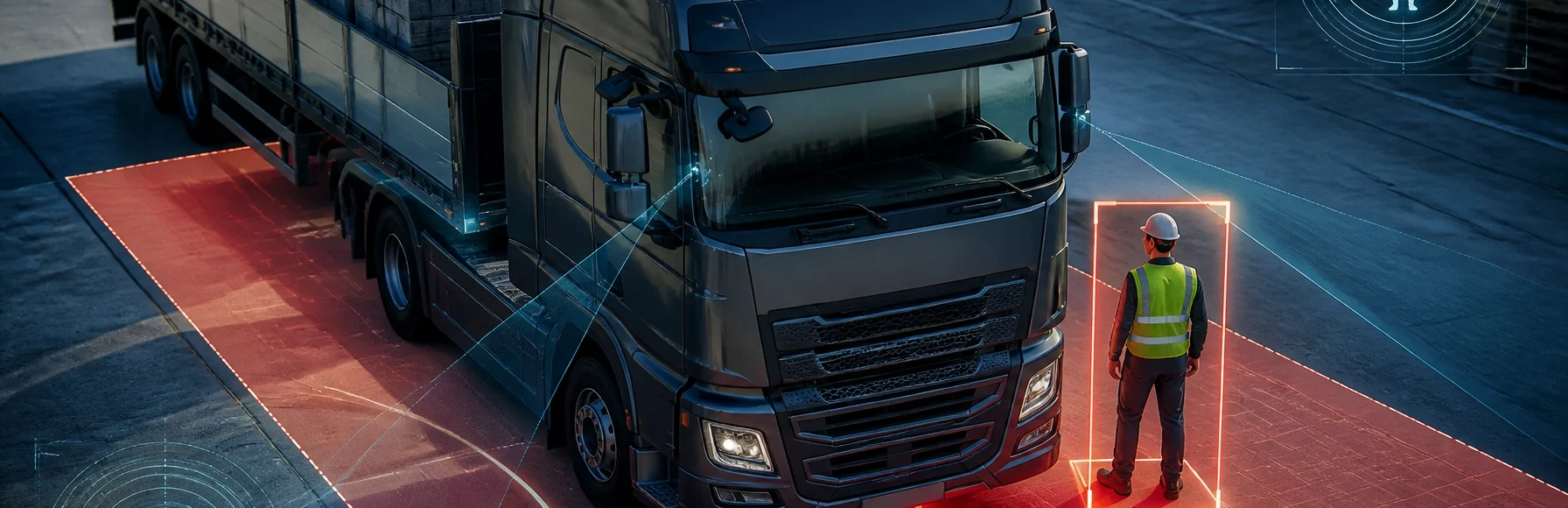
How confident are you that your fleet can detect a person standing in a blind spot before your driver moves?
And if your vehicle cameras only record what happened after an incident, are they really safety systems, or simply evidence systems?
For years, cameras have helped fleet operators review collisions, investigate complaints and coach drivers. That remains valuable. But the expectations around fleet safety are changing.
The next generation of video telematics does more than capture footage. It identifies people in real time, understands where they are in relation to your vehicle and warns your driver before a serious incident occurs.
That technology is called Human Form Recognition, or HFR. It is quickly becoming an important part of modern fleet safety for trucks, plant, waste, civil construction, council and government vehicles.

What is Human Form Recognition, exactly?
Human Form Recognition is AI-powered camera technology that identifies a person or pedestrian based on their human shape and movement.
Unlike a standard camera, which passively records everything in view, an HFR-enabled system actively analyses the live video feed. It can distinguish a person from other objects such as:
- Poles and signs
- Bins and barriers
- Machinery and equipment
- Parked vehicles
- Pallets and materials
- Roadside furniture
When the system detects a person inside a defined risk zone, it can trigger an alert to the driver.
That alert may be visual, audible or both. The level of warning can also be tiered according to the distance, location and movement of the person.
For example, a person detected near the side of a truck may generate an initial visual warning. If the truck begins turning, reversing or moving off, the system can escalate to a louder audible alert.
This is the important difference between passive recording and active protection: the system is not waiting for you to review an incident after the fact.
Why are passive cameras no longer enough?
A camera can show you exactly what happened. It may help you defend your driver, resolve a claim or understand how a collision occurred.
But footage only becomes useful after an event has taken place.
Your driver, meanwhile, is managing traffic, mirrors, pedestrians, cyclists, radio communication, site hazards and vehicle controls. They cannot watch every camera feed continuously. Even an attentive driver can miss a person hidden beside a cab, behind a truck body or near a piece of mobile plant.
This is where HFR adds another layer of protection.
The AI continuously monitors the camera view and draws attention to a specific risk. Instead of expecting your driver to interpret every image, the system helps prioritise the event that matters most: a person entering a danger zone.
For fleets operating in busy depots, worksites, transfer stations and urban streets, that difference can be critical.

What is driving the shift towards active pedestrian detection?
The move towards HFR is not happening in isolation. Regulators and safety bodies in major transport markets are increasingly focusing on vulnerable road users and active detection around heavy vehicles.
The DVS is not an Australian law. However, it demonstrates how fleet safety expectations are evolving. A camera that simply records the nearside is no longer the complete answer. Operators are expected to provide active warnings when a vulnerable road user is detected.
Collisions involving people walking, cycling or riding motorcycles and HGVs have reduced since the DVS was introduced. However, serious incidents continue, which is why the requirements have become more demanding.
These standards cover the situations where heavy vehicles create some of their greatest risks: turning, moving off and reversing.
The framework also includes broader requirements for pedestrian and cyclist detection through advanced emergency braking systems.
Again, this is not a direct Australian compliance requirement for every fleet. But it is a clear signal about the direction of vehicle safety technology and procurement standards worldwide.
Is the same shift coming to Australian fleets?
Australia has its own regulatory framework, operating conditions and fleet safety priorities. The UK and EU requirements do not automatically apply to an Australian vehicle.
However, the underlying safety problem is exactly the same.
Your driver may have limited visibility around a truck, waste vehicle, loader, excavator or service body. People may be working, walking or moving through the same space. A mirror can only show what is visible. A passive camera can only record what the lens captures.
That is why Australian operators are increasingly looking at active pedestrian detection as part of their broader duty of care and risk management approach.
The technology is particularly relevant if you operate:
- Heavy rigid trucks and prime movers
- Waste collection and recycling vehicles
- Civil construction fleets
- Loaders, excavators and other plant
- Council maintenance and infrastructure vehicles
- Government service fleets
- Vehicles working in depots, yards and shared worksites

What practical benefits does HFR provide?
Can HFR warn your driver before a collision?
Yes. HFR can provide real-time, tiered in-cab alerts when a person enters a defined detection zone.
A typical alert structure may include:
- Initial visual alert when a person is detected near the vehicle
- Audible warning when the risk increases
- Escalated alert when the vehicle begins moving, turning or reversing towards the person
The goal is not to distract your driver with constant noise. A properly configured system should focus attention on meaningful events and minimise false alarms from stationary objects.
Can HFR improve protection around blind spots?
This is where HFR delivers some of its greatest value.
A heavy vehicle can have substantial blind spots beside the cab, directly in front of the vehicle and behind the body or trailer. A person may be too close to see in a mirror or may be obscured by equipment.
By using AI to identify human form, the system can actively monitor those risk areas. With suitable installation and configuration, detection accuracy can exceed 95% under defined operating conditions, although performance depends on camera position, lighting, weather, occlusion and the specific operating environment.
No technology replaces a safe system of work or a properly trained driver. HFR gives you another layer of protection when visibility is limited.
Can it help with claims and driver exoneration?
Yes. HFR events can be linked with video footage, GPS location, vehicle speed and telematics data.
That gives you a clearer incident record showing:
- Where the vehicle was
- What the driver was doing
- Whether a person entered the detection zone
- When the alert was triggered
- Whether the vehicle was moving, turning or reversing
- What happened immediately before and after the event
This automated incident and incursion data can help you investigate claims faster, support driver exoneration and identify recurring hazards across your fleet.
Can you upgrade your existing camera system?
In many cases, yes.
You may not need to replace every camera across your fleet. Depending on the hardware, camera inputs and system compatibility, AI processing can be added to an existing camera arrangement or integrated into a broader video telematics platform.
That can make HFR a practical next step for operators who already have cameras installed but want to move from recording towards active safety alerts.
A fleet technology assessment should confirm camera resolution, viewing angles, communications, storage, alert configuration and compatibility before any upgrade is planned.
How does HFR fit into your wider telematics strategy?
Human Form Recognition works best when it is connected to your wider fleet telematics systems, rather than operating as a standalone alarm.
When video, GPS and vehicle data work together, you can move from isolated footage to a complete operational picture.
Your My Fleet camera system can provide live footage, AI-powered event detection, instant alerts, GPS tracking, accident detection and on-demand footage retrieval.
You can also connect HFR events with GPS fleet tracking and visibility to understand where pedestrian risks are occurring. Are incidents concentrated at one depot? One construction site? A particular route, shift or vehicle type?
That insight helps you improve training, site layouts, traffic management plans and vehicle specifications.
It also gives you a more complete approach to GPS fleet management, rather than relying on location data alone.
Is HFR the new safety standard for your fleet?
The direction is clear: fleet safety is moving from passive observation to active detection.
Australian operators are increasingly adopting the same principles because they make practical sense, even where specific regulations do not yet require them.
If your vehicles operate around people, you need to know more than where your vehicle is. You need to know when a person enters a danger zone: and your driver needs to know immediately.
HFR gives you that extra layer of awareness.
If you operate 10 or more vehicles in transport, civil construction, waste, councils or government, now is a sensible time to review your camera capability. Check whether your current system only records incidents or can actively help prevent them.
Talk to My Fleet about video telematics and Human Form Recognition, or explore how telematics for fleets can support safer, more informed operations.