
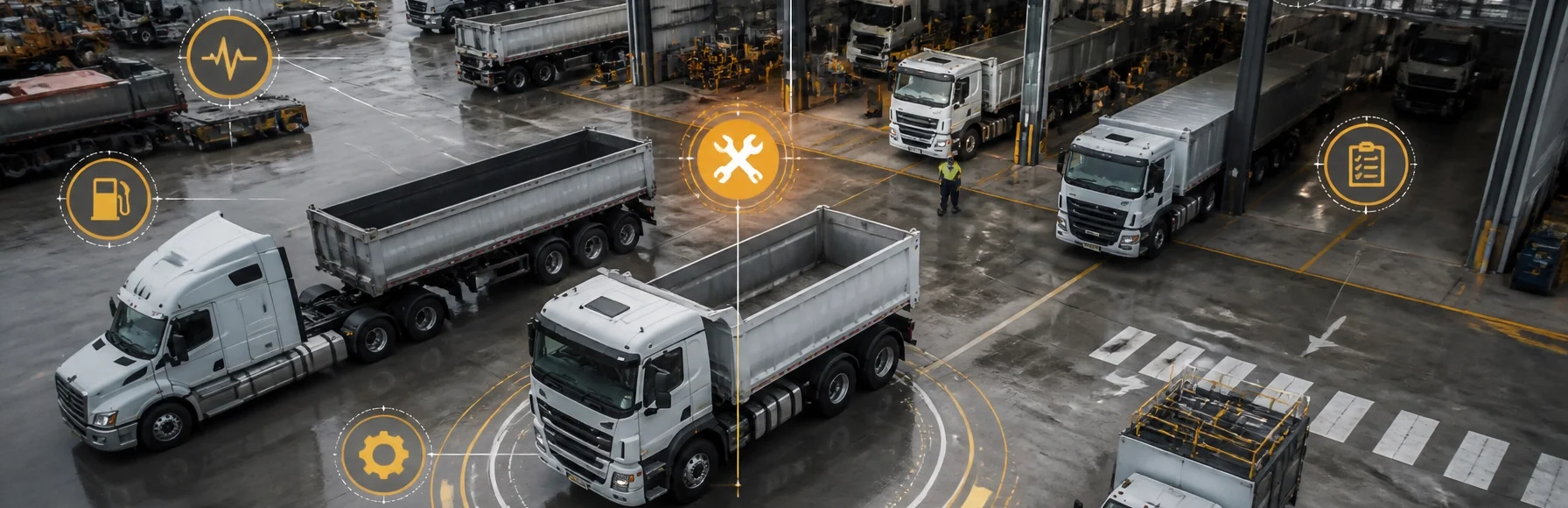
Have you ever watched a prime mover, a civil construction tipper, or a council service utility roll out of the depot on a crisp Monday morning, only to receive a frantic radio call three hours later? A warning light flashes on the dash, the engine derates, and your entire delivery or project schedule grinds to a sudden, costly halt.
If you manage a fleet of 10 or more vehicles across transport, civil works, government departments, or local councils in Australia, you know this sinking feeling all too well. For years, heavy vehicle maintenance has been a reactive game of cat and mouse. You wait for something to break, scramble to find a mechanic, absorb the towing fees, and cross your fingers that parts are sitting on a shelf in Brisbane or Sydney.

But what if your fleet could tell you it was getting sick before it actually keeled over?
As Australian transport operators face stricter regulatory pressures under the NHVR 2026 Master Code of Practice and rising operational expenses, relying on guesswork just doesn’t cut it anymore. That is where modern fleet telematics steps in. Far beyond simple breadcrumb tracking, advanced fleet tracking australia solutions have evolved into intelligent diagnostic powerhouses that transform how you protect your assets, your drivers, and your bottom line.
Why Are We Still Relying on Greasy Paper Logbooks in 2026?
Let’s be honest for a moment. How do daily pre-start checks currently happen in your yard?
If your drivers are still filling out crumpled paper booklets hanging off clipboards: or worse, ticking boxes without so much as glancing at the tyre tread or brake lines: your compliance framework is walking on a tightrope. Under the Heavy Vehicle National Law (HVNL) and Chain of Responsibility (CoR) obligations, a missing signature or an unrecorded hairline crack in a windscreen can land your business in serious hot water during an audit.

Transitioning to digital pre-start inspections via a robust fleet tracking platform changes the game completely. When your team pulls out a smartphone or tablet in the cab to complete their mandatory pre-start checklist, every input is time-stamped, geofenced, and instantly synced to a centralized dashboard.
If a driver flags a worn brake pad or an electrical fault, the system doesn’t wait for the clipboard to make its way back to the depot manager on Friday afternoon. It fires an instant notification.
By digitising your pre-start process, you achieve a 60-80% reduction in maintenance admin. No more chasing lost paperwork, no more manual filing cabinets, and zero ambiguity when safety auditors or NHVR inspectors come knocking. You have immediate, audit-ready proof that your vehicles are roadworthy before they even turn a wheel.
What Happens When Your CAN Bus Starts Talking in Real Time?
Most fleet managers think of gps fleet management as a tool that simply tells them where a truck is parked on a map. But if your system isn’t tapped directly into the vehicle’s CAN bus (Controller Area Network), you are only seeing half the picture.
Modern fleet telematics plugs straight into the vehicle’s electronic control units, pulling a constant stream of raw health data straight from the engine, transmission, and braking systems.
Instead of waiting for an amber dashboard light to be ignored by a driver until it turns red and destroys a turbocharger, you receive real-time Diagnostic Trouble Codes (DTCs) sent straight to your phone or desktop dashboard.
- Overheating coolant levels? You know instantly.
- Abnormal DPF (Diesel Particulate Filter) soot accumulation? You can schedule a regeneration cycle before it triggers limp mode on the Hume Highway.
- Intermittent voltage drops? You can replace an alternator in the depot rather than paying for an emergency roadside rescue in the remote outback.
This proactive shift from reactive scrambling to real-time alerting is why leading transport and civil operators across Australia are seeing up to a 45% reduction in unplanned downtime.
When you combine this level of engine visibility with reliable transport and logistics solutions for modern fleet management, your entire operation shifts from firefighting to smooth, predictable execution.
Can Predictive Analytics Really Cut Your Maintenance Costs by 30%?
Let’s talk numbers, because in the transport and contracting game, margins are tight and every dollar counts.
When you deploy a comprehensive fleet manager gps and telematics ecosystem, the financial impact isn’t just marginal: it’s transformative. Industry data and real-world deployments show clear, measurable benchmarks:
- 25-30% reduction in overall maintenance costs by catching minor component wear before catastrophic failure occurs.
- 45% less unplanned downtime, keeping your revenue-generating assets on the road where they belong.
- 60-80% reduction in maintenance administration, freeing up your mechanics and workshop managers to focus on skilled repairs rather than paperwork.
- A proven 3:1 ROI in your very first year of implementation.

How do these savings add up so quickly? Consider the cost of a single major engine failure on a heavy tipper or prime mover. Between towing, overnight accommodation for the driver, expedited heavy-duty parts freight, lost contract penalties, and workshop overtime, a single breakdown can easily eclipse the annual subscription cost of an enterprise-grade telematics setup.
By tracking engine hours, idle times, fuel burn rates, and historical component wear patterns, predictive algorithms tell you precisely when a part is approaching the end of its useful life. You replace the water pump during scheduled routine servicing on a Tuesday evening, rather than having it seize on a remote highway on Friday morning.
For more insights on streamlining your operational reporting, check out how fleet management software can handle all of your reporting automatically.
How Does This Make Your Life Easier as an Australian Fleet Manager?
Managing a mixed fleet across diverse Australian terrains: from scorching Pilbara mining access roads to tight urban council streets in Melbourne: brings unique challenges. You don’t need another clunky piece of software that creates more headaches than it solves.
This is where consolidating your operations matters. Bouncing between separate tools for GPS tracking, maintenance logs, video evidence, and compliance reporting drains your time and energy. As highlighted in our guide on why a single platform is the secret to modern fleet tracking, bringing everything under one unified roof changes everything.

When your telematics system talks seamlessly to your maintenance schedules, your workshop team knows what parts to order before the truck arrives. Your drivers spend less time filling out paperwork and more time moving freight safely. And you get peace of mind knowing your fleet fully complies with the latest NHVR standards and Chain of Responsibility regulations.
Ready to Transform Your Fleet Maintenance From Reactive to Proactive?
You don’t have to keep playing guessing games with your vehicle maintenance schedule.
As your trusted Australian telematics partner, MyFleet provides robust, end-to-end solutions designed specifically for Australian transport operators, civil contractors, government agencies, and local councils with 10 or more vehicles.
Stop letting unexpected breakdowns eat into your profits and stress your team out. Get in touch with the My Fleet team today to book a personalized demo and discover how our advanced telematics technology can deliver a 3:1 ROI for your business in year one.