
![[HERO] Accident investigation with tablet showing dashcam video and simplified claims checklist](https://cdn.marblism.com/UKoWxil6CBq.webp)
How long does your fleet spend dealing with insurance claims after an accident? Days? Weeks? If you’re like most Australian fleet managers, the answer is probably “way too long.” And while you’re stuck chasing paperwork, disputing liability, and defending your drivers, your vehicles are sitting idle and your admin team is drowning.
So when you hear that 70% of fleets say video telematics dramatically cuts claims processing time, it sounds too good to be true. But here’s the thing, over 500 Australian and New Zealand fleets have now shared their results, and the numbers back it up.
Let’s break down what they discovered, and more importantly, what it means for you.
What Does That 70% Figure Actually Mean?
First, let’s clear something up. The 70% doesn’t mean claims are resolved 70% faster (though many are). It means 70% of surveyed fleets reported that combining cameras with telematics significantly reduced the time needed to process accident claims.
That data comes from Teletrac Navman’s “Mobilizing the Future of Fleets: 2026 Risk and Exoneration Edition” report, a comprehensive study of fleet operators across Australia and New Zealand. And if seven out of ten fleets are seeing faster claims resolution, you have to ask yourself: what are they doing differently?

The answer is simple. They’re using video evidence to cut through the ambiguity, finger-pointing, and endless back-and-forth that normally drags claims out for months.
The Real Problem: Claims Take Forever Because Nobody Knows What Happened
Here’s what a typical insurance claim looks like without video telematics:
Your driver gets hit. They file a report. The other party files their version. The insurer asks for more information. You chase down witness statements. The other side disputes liability. Legal teams get involved. Months pass. Your vehicle sits in a repair yard. Your driver is stressed. Your premium goes up.
Sound familiar?
The core issue is this: without objective evidence, every claim becomes a he-said-she-said battle. And insurers, understandably, take their time when liability isn’t crystal clear. They want statements, police reports, diagrams, maybe even third-party investigators.
But when you can hand over timestamped, multi-angle video footage within hours of an incident? The entire game changes.
What 500+ Australian Fleets Actually Discovered
Let’s talk specifics. Here’s what fleets using video telematics are reporting:
Claims that used to take months now settle in hours. When your insurer can see exactly what happened, from multiple camera angles, with GPS coordinates and speed data, there’s no debate. Liability is determined quickly, and you move straight to resolution.
53% of fleets successfully exonerated drivers using video evidence. Think about that for a second. More than half of the fleets that experienced accidents in the past 12 months were able to prove their driver wasn’t at fault, using telematics and video data. That’s not just faster claims. That’s protecting your people from unfair blame, stress, and potential job consequences.

34% of fleets reported being impacted by fraudulent motor claims. Staged accidents, exaggerated injuries, false liability claims, they’re more common than you’d think. Video telematics doesn’t just speed up legitimate claims; it shuts down fraudulent ones before they spiral into costly legal battles.
And here’s the financial kicker: 65% of fleets recorded premium decreases after implementing video telematics. When your insurer sees you’re proactively managing risk and providing clear evidence, they reward you for it.
How Video Telematics Actually Works in Practice
You might be wondering: how does this technology actually make claims faster?
It starts the moment an incident occurs. Modern video telematics systems automatically detect sudden braking, impacts, or sharp manoeuvres. Within seconds, your system captures footage from multiple cameras, front, rear, sides, even driver-facing if you have that enabled.

That footage is instantly timestamped, paired with GPS coordinates, vehicle speed, and g-force data. You get a complete, objective picture of what happened. No guesswork. No conflicting stories.
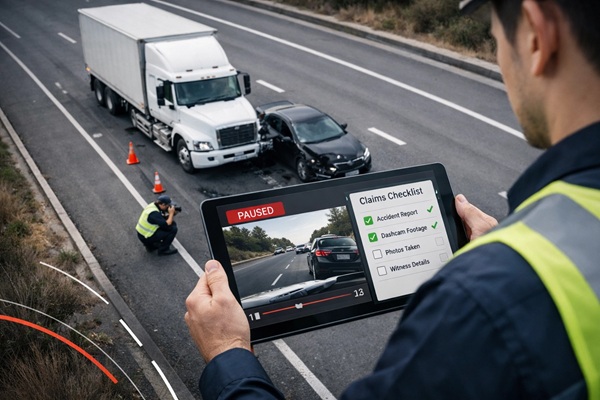
Now, instead of waiting days to gather statements and reports, you can log into your telematics platform, review the incident footage, and immediately determine whether your driver was at fault. If they weren’t, and let’s be honest, they often aren’t, you can share that video with your insurer or legal team the same day.
The result? Claims that used to drag out for 8-12 weeks can be resolved in a matter of days, or even hours.
One fleet manager put it this way: “We had a rear-end collision on the M1. The other driver claimed our truck cut them off. We sent the video to our insurer that afternoon. Case closed by the end of the week. No dispute, no stress, no inflated claim.”
The Driver Exoneration Factor You Can’t Ignore
Let’s talk about your drivers for a minute. They’re out there every day, navigating traffic, dealing with aggressive drivers, and managing tight schedules. And when an accident happens, even when it’s not their fault, they’re often the ones who take the heat.
Without video evidence, your driver’s reputation is on the line. Their license points might be at risk. Their confidence takes a hit. And if they’ve been unfairly blamed for an incident, the damage to morale can be lasting.
Video telematics changes that dynamic completely.
When your drivers know there’s a camera capturing everything, they drive more carefully. And when an incident does occur, they know they’re protected by objective evidence. That peace of mind matters.
The data backs this up. 53% of fleets that had accidents were able to use video and telematics data to exonerate their drivers. That’s more than half of incidents where the driver would have otherwise been blamed, stressed, or penalized, now resolved fairly and quickly.

If you’re serious about safety and retention, protecting your drivers from unfair blame isn’t just nice to have, it’s essential.
The Insurance and Cost Benefits Are Real
You didn’t get into fleet management to negotiate with insurers. But here you are, spending hours disputing claims, justifying premium increases, and absorbing costs that shouldn’t be yours in the first place.
Video telematics flips the script.
When insurers see you’re using proactive risk management technology, they take notice. You’re not just reacting to incidents, you’re actively preventing them and providing clear evidence when they do occur. That makes you a lower-risk client.
The numbers speak for themselves:
- 65% of fleets saw premium decreases after implementing video telematics
- Claims typically drop by 20-30% for fleets actively using telematics
- Some fleets report claim reductions exceeding 50%

And it’s not just about lower premiums. When claims are resolved faster, your vehicles get back on the road sooner. Your admin team spends less time on paperwork. Your drivers aren’t sitting around waiting for investigations to conclude. The operational efficiency gains compound quickly.
So, Does Video Telematics Really Cut Claims Time?
If 70% of fleets say yes, and the evidence shows claims settling in hours instead of months, and drivers are being exonerated more than half the time, and premiums are dropping by double-digit percentages, then yes. The answer is unequivocally yes.
But here’s the real question: why are you still managing claims the old way?
Every day you operate without video telematics, you’re accepting longer claims processes, higher insurance costs, and unnecessary stress on your drivers. You’re also leaving yourself vulnerable to fraudulent claims and liability disputes that could have been shut down with a 30-second video clip.
Australian fleets are already seeing the results. The technology is proven, the ROI is clear, and the benefits extend far beyond just claims management: into safety, driver behaviour, and operational efficiency.
Ready to See What Video Telematics Can Do for Your Fleet?
If you’re managing a fleet of any size: whether it’s 5 vehicles or 500: the insights from these Australian fleets should make you pause and reconsider your current approach to claims and risk management.
Video telematics isn’t just about faster claims. It’s about protecting your drivers, reducing costs, improving safety, and running a smarter operation. And with over 500 fleets reporting measurable results, the case has never been stronger.
Want to learn more about how My Fleet’s video telematics solutions can help your operation reduce claims time and protect your drivers? Let’s talk about what’s possible for your fleet.