
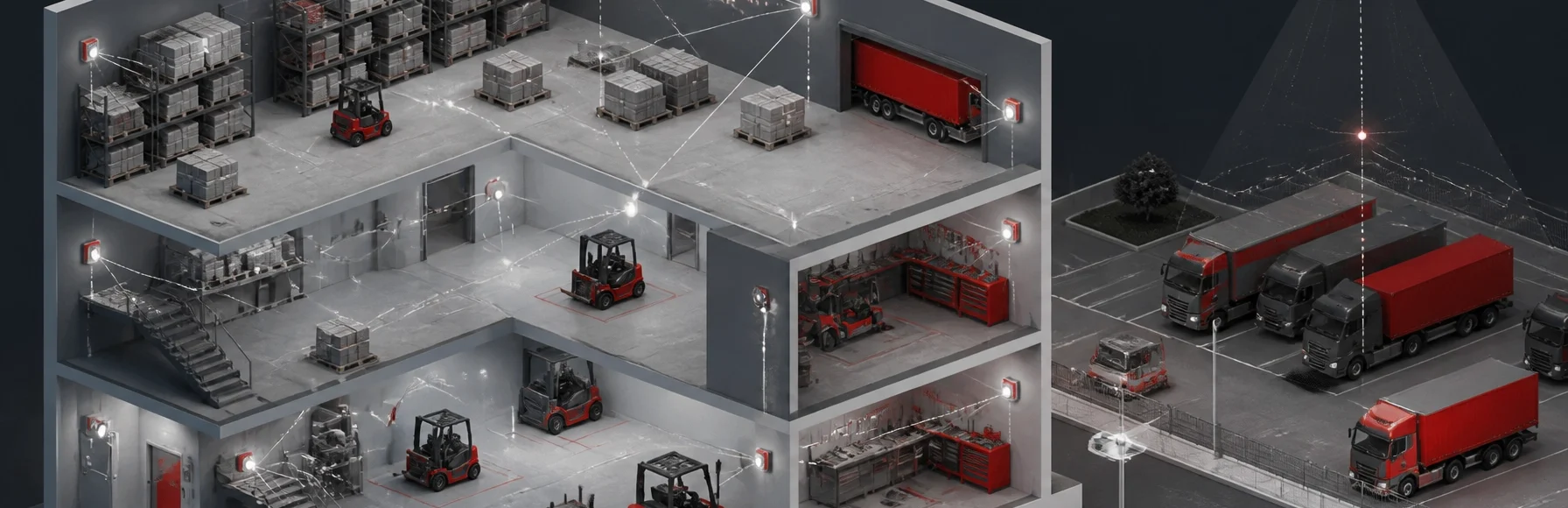
What happens when your truck leaves the road and enters the depot?
Can your current fleet tracking system tell you which workshop bay it is in, where the trailer attachment has gone, or whether a temperature-sensitive load is still inside the correct zone?
For many Australian fleet operators, GPS fleet management works brilliantly outdoors. You can see where your vehicles are, monitor routes, review driver behaviour and manage movements across the road network.
But GPS has a blind spot.
It becomes less useful inside workshops, warehouses, undercover parking areas, transfer stations and large depots. That is where Bluetooth Low Energy (BLE) beacons are changing the conversation.
BLE tracking is moving beyond simple “seen or not seen” detection. Newer systems can support indoor positioning, condition sensing and mesh networks that extend coverage across complex sites.

What did BLE tracking used to tell you?
Traditional BLE beacon systems answered a fairly simple question:
Is this tagged asset near a specific beacon or gateway?
For example, you could attach a BLE tag to a trailer, tool or piece of plant and install a gateway at the depot entrance. When the tag came within range, the system recorded that the asset had been seen.
That was useful for basic zone detection:
- The trailer is in the yard.
- The service vehicle is near the workshop.
- The tool is inside the depot.
- The attachment has left the site.
However, “seen” does not necessarily tell you where an asset is now.
If a large yard contains several trailers, a workshop and multiple storage areas, knowing that an asset is somewhere on the property still leaves your team with a search problem. You may have reduced the size of the haystack, but you have not found the needle.
That limitation is now changing.

How is BLE moving beyond proximity detection?
Modern BLE systems use signal information from multiple receivers, tags or beacons to estimate an asset’s location within a building or site.
Depending on the hardware, software and site layout, the system may provide:
- Room-level or zone-level positioning
- Approximate coordinates on a digital map
- Entry and exit events
- Time spent in a workshop, staging area or loading zone
- Movement history
- Temperature and humidity readings
- Door-open or door-closed status
- Shock, vibration or motion alerts
In practical terms, that could mean moving from:
> “The excavator attachment is somewhere at the depot”
to:
> “The attachment is in the maintenance workshop, near Bay 4.”
The level of accuracy depends on how the system is deployed. Standard signal-strength-based BLE positioning may provide accuracy in the range of a few metres, which is often enough for zone-level fleet tracking. More advanced approaches, such as Bluetooth direction finding, dense receiver layouts and calibrated indoor maps, can support sub-metre accuracy in controlled areas.
You should match the accuracy to the problem you are trying to solve. If you only need to know whether a vehicle is in a workshop or yard, you may not need a high-precision system. If your team needs to find a specific tool in a multi-level warehouse, more detailed positioning may be worth the investment.
What is the difference between direct BLE and a mesh network?
Direct BLE is generally the simpler option.
A BLE tag attached to a tool, attachment or asset broadcasts its identity. A nearby gateway, vehicle device or connected smartphone detects the signal and sends the information to your fleet tracking platform.
This approach works well when:
- Assets stay close to a known gateway
- You are tracking tools inside a service truck
- You need a vehicle to report nearby equipment
- You want basic zone entry and exit events
- Your depot is relatively small or open
For example, a civil construction service truck could carry tagged tools, pumps and attachments. When those items are near the truck’s connected device, your team can see what is present. If a tool is missing before the vehicle leaves site, an alert can be generated.
A mesh network is better suited to a high-density, complex indoor environment.
In a mesh architecture, compatible nodes can relay messages through one another. Instead of every beacon or sensor needing a direct connection to one central gateway, data can move across multiple connected points throughout a warehouse, factory, workshop or multi-level depot.
That can improve coverage in places where direct communication is difficult because of:
- Large buildings
- Concrete walls
- Metal racking
- Heavy machinery
- Multiple floors
- Long distances between assets and gateways
- Assets moving independently between rooms
A key point is that BLE mesh and indoor positioning are related, but they are not exactly the same thing. The mesh helps move data across a site. Positioning is calculated using signal strength, direction, timing, mapped zones or a combination of methods.
Could a gateway-less system reduce infrastructure requirements?
In some emerging solutions, yes.
A gateway-less or reduced-infrastructure approach uses connected devices that are already operating in the field. This might include:
- Smartphones
- Tablets
- In-vehicle displays
- Connected service vehicles
- Mobile workforce devices
- Existing site-connected equipment
These devices can detect nearby BLE tags and pass the information back to your software platform.
For a fleet operator, this can reduce the need to install hardwired gateways throughout every workshop, shed or yard. It does not mean that infrastructure is never required. A large warehouse needing continuous, accurate, server-based positioning may still benefit from fixed receivers or mesh-capable nodes.
The important shift is flexibility.
You can build a BLE deployment around the way your operation actually works, rather than treating every site as a one-size-fits-all installation.
Where does BLE fit into Australian fleet tracking?
Think of GPS and BLE as complementary technologies, not competing ones.
GPS covers the open road. BLE covers the places GPS cannot reliably see.
That makes BLE particularly relevant to Australian transport companies, civil construction fleets, councils, government departments, waste operators and businesses managing 10 or more vehicles.
Useful applications include:
Finding tools and attachments in the yard
Tag excavator buckets, plates, pumps, generators, trailers and other high-value attachments. When someone needs a particular item, they can check its latest zone rather than relying on memory or walking the yard.
Tracking assets through a workshop
Record when a vehicle or asset enters a workshop, moves between bays and leaves for service. This can help you identify bottlenecks and understand how long equipment spends waiting between jobs.
Locating forklifts and mobile plant
Large warehouses and depots often have equipment moving between loading bays, storage areas and maintenance zones. BLE location data can support utilisation reporting and zone-based alerts.
Monitoring temperature-sensitive loads
BLE sensor tags can report temperature and humidity alongside location. If a pallet is in the wrong staging area or a cool-room door remains open, you can act sooner.
Managing transfer stations and waste facilities
Waste and recycling operations can involve large sites, multiple zones and heavy equipment. BLE can help you track mobile assets inside sheds and undercover areas where GPS visibility becomes inconsistent.

What business benefits can you expect?
The value of BLE is not the signal itself. The value comes from what you can do with the information.
With the right setup, you can reduce the time your team spends hunting for equipment. Even a small saving can add up. If three employees each spend 15 minutes searching for an attachment every working day, that represents more than 195 hours of lost time across a year.
BLE can also help you:
- Improve asset utilisation
- Reduce unnecessary equipment purchases
- Identify idle or underused plant
- Improve workshop workflow
- Support zone-based compliance
- Create better maintenance records
- Protect temperature-sensitive goods
- Build a clearer chain of custody
- Respond faster when assets move unexpectedly
The data becomes more valuable when it connects with your existing systems. BLE platforms may integrate through MQTT or HTTP APIs with fleet management software, warehouse management systems, maintenance platforms and operational dashboards.
That means your team does not need to manage another isolated screen. The goal is one operational view that combines vehicle location, asset status, indoor zones and relevant alerts.
What should you consider before deploying BLE?
Before you tag every asset on site, start with one clear operational problem.
Ask yourself:
- Which assets are most often misplaced?
- How much time does your team spend searching for them?
- Do you need a zone, room or coordinate-level location?
- Are assets moving independently, or mostly staying with vehicles?
- Does the site have multiple buildings or floors?
- Do you need condition data such as temperature or door status?
- Can existing connected devices act as receivers?
- Which systems need to receive the data?
You should also consider building materials, metal structures, receiver placement, battery life and the accuracy your team genuinely needs. A practical pilot in one workshop or depot can show whether BLE solves a real problem before you expand across the whole operation.
How can you connect BLE with your existing GPS fleet management?
The strongest approach is usually not replacing your GPS fleet tracking. It is extending it.
Your GPS telematics platform can continue to show where vehicles are travelling, how they are being used and what is happening on the road. BLE can add visibility once those vehicles, tools, attachments or loads move indoors.
My Fleet can help you bring GPS, telematics and asset visibility together in one platform. Our fleet tracking and visibility solution provides live vehicle location, site management, utilisation insights and asset data. You can also explore our telematics software for integrated data and operational reporting.
The result is a clearer view of your fleet from road to depot, from workshop to warehouse.
Is your fleet still relying on “somewhere on site”?
BLE beacons and mesh networks are making indoor fleet tracking more practical, scalable and useful.
You can move beyond knowing that an asset was last seen at a gateway. You can start understanding where it is, what condition it is in, how long it has stayed there and whether its movement matches your process.
For Australian fleets, that matters because your operation does not stop when a vehicle leaves the highway. Your assets continue moving through depots, workshops, yards, sheds and transfer stations.
If you are ready to reduce asset search time and connect indoor visibility with your existing GPS fleet management, contact MyFleet to discuss your sites, assets and tracking requirements. Our Australian-based technicians can help you assess whether direct BLE, mesh networking or a gateway-less approach fits your operation.